≡ Menu

RADIO ADVERTISING CRITIQUE: Branding Commercial

Greg Lowe of CKBW/CJHK writes:

“Our sales department really enjoyed Tuesday’s’s radio branding seminar. We actually started branding for many of our clients a couple of years ago. More and more seem to be going in that direction. Here’s one that just hit our airwaves last month….It’s one of our best. What do you think?”

It’s a lovely, genuinely moving radio advertisement.

Here are a few things that could improve it.

1.  If you’re locked into a 30-second spot, you need to edit more. “Branding” requires more than sticking your name somewhere on the commercial. This needs some sort of Call To Action — even if it’s only implied (e.g., by including the Web address, if that’s the most common first contact for prospects, or by alluding to the physical location).

If there were more time, you could tell the story and then invite the targeted listener to respond:

“Provincial Hearing Services, on Hillcrest at Dufferin.” (Thanks, Google Maps.)

But I’d hate to lose the emotional impact at the end of the commercial.

Solution?

(WOMAN) And tears started rolling down her face.

(ANNOUNCER) Provincial Hearing Services, on Hillcrest at Dufferin. Enhancing people’s lives.

(OPERA VOICE — the one note that ends the original version of the spot)

If you move the announcer tag to the end and have the opera singer’s solo note as the last sound in the commercial, that sung note punctuates both the “sales message” and the emotional thread of the story.

Also, placing the advertiser’s name at the end would tie it in to the emotional connection the story has established. Saying it 2 seconds into the advertisement, however, squanders the time because at that point there is no emotional experience to be associated with the advertiser.

2. By following the standard (and usually ineffectual) structure of having an announcer interrupt the storyteller to identify the person who’s speaking, you also interrupt the very story you’re attempting to tell.

In the original version, the placement of the announcer’s voice immediately dampens the listener’s memory of the story’s opening line.

Notice how much stronger it is if you just let her tell her story:

Here’s a quickly edited version of the story you just heard:

I removed 5 seconds from the story, thereby freeing up an additional 5 seconds for the announcer to make the connection at the end.

That’s 5 seconds of a 30-second radio commercial. Did the story sound weaker? Did you miss anything that had been in the original version?

3.  If you ignore all of the advice I’ve given so far, at least do this one thing: Replace the “Radio DJ” voice with a gentle (not faked sincere, but honestly gentle and respectful) voice.

I know the jock who voiced the part is wincing now. I’m not saying he shouldn’t be on the spot. In fact, I’m saying the opposite: Those words should be spoken by the genuine human being I’m sure that announcer really is.


P.S. Registration for the world’s most advanced radio copywriting course now is open.

{ 6 comments }

HAPPY BIRTHDAY TO ONE GREAT RADIO GUY

Happy Birthday, Terry Moss

Each year I publish a version of this birthday greeting to one of the most creative, most talented and nicest radio people ever, Terry Moss.

Terrry’s biggest contribution to radio personalities around the world continues to bring smiles to DJs and listeners alike: Cheap Radio Thrills — the best and best-selling radio production library of all time.

As any old American DJ will confirm, for many years radio stations were required to broadcast periodic tests of the Emergency Broadcast System. Here’s what the listener would hear:

For the next 60 seconds, this station will conduct a test of the Emergency Broadcast System. The following is only a test.

That would be followed by this test tone:


Then the announcer would return to say:

This is a test of the Emergency Broadcast System. The broadcasters of your area in voluntary cooperation with the FCC and federal, state, and local authorities have developed this system to keep you informed in the event of an emergency. If this had been an actual emergency, the Attention Signal you just heard would have been followed by official information, news, or instructions. This station serves the [ ] area. This concludes this test of the Emergency Broadcast System.

Invariably the jock would read that copy in a monotone, there’d be silence, then the test tone, then the jock would return to read the close with the same disinterested inflection.

Terry decided to change all that — with these two cuts from Cheap Radio Thrills. Here’s the introduction:

After the intro, the test tone would be broadcast. Then this cut would be played, complete with a donut for the announcer to read the boilerplate copy that begins, “The broadcasters of your area…”

Question: As a listener, which test would you be more likely to pay attention to? The one delivered in the bored monotone, or the musical version?

Clearly far more people would actually listen to the musical rendition — which really upset the FCC. People actually paying attention to the E.B.S. tests??

So in its infinite wisdom, the FCC decreed that the Emergency Broadcast System test could not be sung.

Bored monotone that no one listens to = Good.

Entertaining version that many people listen to = Bad.

Happy birthday, Terry. I was a few days late this year, but I know you’ll forgive my tardiness.

{ 4 comments }
radio promotion idea

Recently I’ve been urging radio stations to look for “lemonade moments” they can create for their listeners, advertisers, sponsors, vendors — anyone with whom they regularly come into contact.

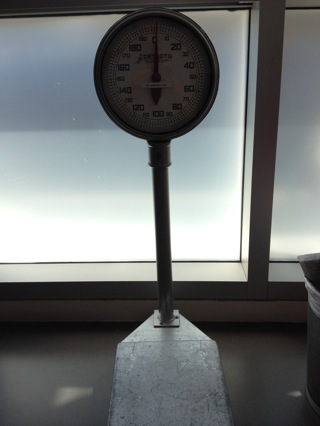
This isn’t much of a photograph, but it’s another brilliant lemonade moment from the Custom Hotel in Los Angeles. I snapped this photo when we visited to confirm this would be the location of our 2012 Sitcom Room TV sitcom writing class.

It’s a scale. In the lobby, close to the Front Desk, next to the strawberry ice water.

Why is it there?

For departing guests, who are worried that their luggage will exceed the airline’s maximum weight limit.

Absolutely brilliant. A one-time investment in a used scale that will cause countless future guests to leave the Custom Hotel for the airport thinking, “That was great of them, having that scale there for us….”

So again I ask: In your radio station’s (or other business’) daily routines, where are your opportunities to create lemonade moments for others?

{ 2 comments }

Thom Whetson submitted this a while ago. Finally I have time to share it with you:

“Great moments in advertising: A radio local station is running nicely done spots for businesses to ‘use VMware to virtualize their server needs.'”

Radio advertising solves problems.

Very few people in that station’s listening audience awakened this morning thinking, “By golly, I’ve just got to virtualize our company’s server needs!”

Thom kindly explained that “virtualizing your server needs” = “paying only for the computing power you need.”

Oh! I’m sure there are business owners in his market who are thinking, “We need to upgrade to a more powerful computer system, but I just don’t see how we can afford it.”

Too bad the commercial didn’t say anything like that….

P.S. Although I’ve haven’t formally announced it yet, I’ve just opened registration to my annual Radio Copywriting Masters class. Limited to just 12 attendees. Are you (or is your employer) serious enough about producing results from the radio campaigns you create?

Here’s the radio copywriting class video.

{ 0 comments }

Recently I worked with a couple of different European radio stations — a morning show tune-up with one, an AIR PERSONALITY PLUS+ seminar for another.

Like many stations around the world, they love to quote listeners’ text messages on-air.

Why is this often a mistake?

It was Paige Nienaber who first pointed out to me that radio people tend to use new technology to distance themselves from their listeners. Texting (or SMS) is an excellent example.

The most powerful sound you can broadcast is the human voice.

Forget, for the moment, how cool it is to get dozens or hundreds of text messages or e-mails from listeners.

Instead, view them from the listener’s perspective:

Which is more compelling — hearing a listener on-air, or hearing a jock read words written by a listener?

Having a jock read a listener’s written message is lifeless.

It’s dull.

And it’s completely lacking in spontaneity and risk.

When you’ve got a listener on the air, anything can happen.

Even if it’s recorded and edited prior to broadcast, it should sound live and “dangerous” (“dangerous” = “anything can happen”).

But there’s no way to create the feeling that an e-mail or SMS is “live,” let alone “dangerous.” By definition, before it can be read on-air someone had to write it and send it to the jock.

Recommendation:  Use e-mails and SMS for gathering large quantities of listener response— listener polls, rate-a-record, etc.

But for listener comments? Whenever possible, put the human voice on your airwaves.

{ 2 comments }