An auto repair shop that devotes any of its radio commercial to boasting about having “factory trained mechanics” is like a dental practice declaring, “Our dental hygienists are licensed!”
While plenty of automobile mechanics aren’t “factory trained,” that has more meaning to the shop than it does to potential customers.
The advertiser might think that should be an important selling point. But people want a good mechanic who is honest and reliable.
Being “factory trained” is not an assurance of expertise, of honesty, or of reliability. It might well be something the mechanics are proud of, but it shouldn’t be in the radio commercial.
Use your precious advertising time to solve the targeted consumer’s problem, not to answer questions the consumer isn’t asking (“Are your mechanics factory trained?”).
Most disc jockeys learn the basics…and then coast for the rest of their professional lives.
They have jobs, not careers.
Let’s face it: The technical demands of being a radio personality are about on a par with driving a car with manual transmission. It just ain’t that difficult.
To have a career in radio and not just a job, you need to develop a mastery of performing skills.
But delivering the goods to your audience isn’t always enough to insure professional longevity. It also pays to promote yourself within the industry and to make friends within your profession.
I hate the word “networking,” because it implies spending all of your energy handing out business cards and looking to make “contacts.”
But having friends in the industry can be of immense help — for mutual support, inspiration, advice and, yes, even jobs on occasion.
It’s equally valuable for copywriters, comedy writers and radio personalities. (It won’t help much with voice tracking.)
Why improv? Especially “my” version of improv?
For me, improvisation is discovering reality where moments ago there was nothing.
That sounds New Age-y until you realize that’s what we experience constantly in our lives. We’re minding our own business, something happens, we react, and now we’re “fully committed” to a new “scene.”
We don’t have to pretend; we don’t even have to try. It just happens. All we need to do is be conscious, pay attention, and respond to life.
If you decide to join us, don’t worry about “being funny.” All you’ll need to do is “be real.” And you are real, aren’t you?
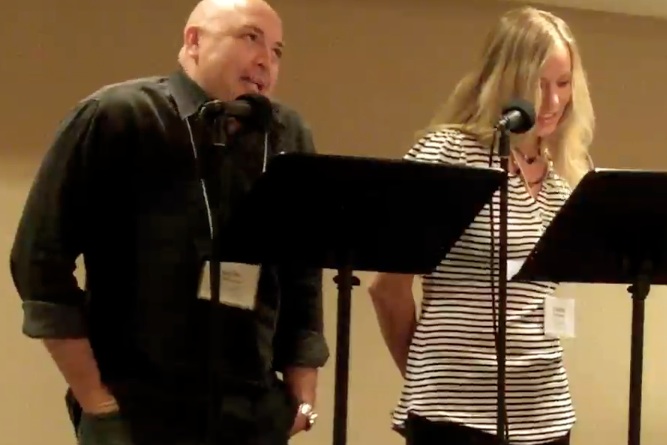
Admittedly, improvisation is scary. Notice how terrified those guys are?
(Photos taken from an abbreviated workshop version I conducted at our last Radio Production Summit.)
I don’t try to get people to give “better” performances. My job is to help them discover new approaches.
I call it “discovering reality.”
One of my favorite techniques involves the creation of “backstories.”
But not in the way you’d guess; the backstories I give voice actors often have nothing to do with what’s on the page.
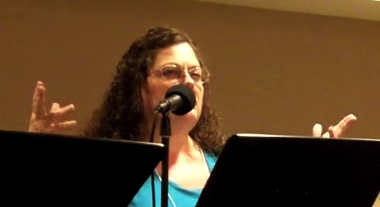
For example, here’s a very good voice actor delivering her first take on a piece of radio commercial copy.
Then I give her a backstory that in no way is suggested by the copy.
Then she delivers a completely different, more interesting performance.
Yes, if she were to use that newly discovered attitude & voice, her delivery would need to be speeded up to fit the small commercial frame.
But that wouldn’t have been difficult. Her new character wasn’t different because she talked slowly; that same character could speak more quickly while preserving the attitude that gives her that special quality.
Do you agree — was the second read clearly more interesting and compelling?