≡ Menu

May, 1995 (continued): Despite the amount of traveling I do, I never run into people I know in airports…at least, not in the U.S. But while browsing among the gift shop stalls in the airport at Bogotá, Colombia (where I was awaiting my flight back to Los Angeles and where I purchased the deteriorating leather wallet I still insist on using), a voice behind me said, “Hello, Dan!”

I turned to see the smiling face of Radio Express’ Barbara Rounds. (She, too, lives in L.A., but I’ve never bumped into her there.)

Here is the security process I went through upon entering the Bogotá airport that morning:

1. Before I was allowed to enter the airport from the sidewalk, I had to be frisked by a soldier. (I believe that’s the first time I’d ever been frisked.)

2. Before I was allowed to approach the ticket counter, all of my belongings were scanned by an x-ray machine.

3. After checking in at the ticket counter, I went through Immigration.

4. After Immigration, before I could reach my gate my carry-on luggage was x-rayed (again).

radio advertising graphic

Extra Strength Excedrin

5. Before I was allowed to enter the jetway to board the plane, I stood in a fairly long line to have my carry-on luggage opened and the contents examined by a police officer. My bottle of Extra-Strength Excedrin aroused his suspicion, and an intense conference with two of his colleagues followed.

One of them gave me a long, hard stare — obviously with the intent of intimidating me. I, however, am too stupid to be intimidated, so I simply returned his glare.

6. After passing this inspection, I handed my boarding pass to a gate agent, who waved me on toward the jetway.

7. Just a few feet inside the jetway was a female police officer, who frisked me (again!). This was not an altogether unpleasant experience.

Next Week: A quickie French lesson on an international flight.
{ 0 comments }
radio music copyright graphic

Ellie Greenwich

I’m not going to write a tribute to Ellie Greenwich, because I don’t know enough about her or her body of work to do justice to either.

I do, however, know more about her music than the idiot pop critic for my local newspaper, who implies that “Leader of the Pack” is a great song (it was a big hit but virtually a novelty record due to its way over the top production & performance) while dismissing “And Then He Kissed Me” as “light as a cotton.”

Ask a woman who was 13 to 16 years old when “And Then He Kissed Me” was a hit how important that song was to her.

And what song did that pop critic dummy omit entirely in her recounting of Greenwich’s career highlights? Only the one that truly is iconic of ’60s pop: “Da Doo Ron Ron.”

The Simpsons’ Matt Groening is right: There is no lower form of intelligence than a pop music critic.

But that’s not what I want to talk about.

I’m here today to publicly thank Ellie Greenwich for not suing me.

In 2002, the Enron scandal broke. As I read about all those people whose lives were ruined by greedy, thieving bastards who would do anything to obtain and keep their private jets and multiple mansions, I became infuriated. Livid. Filled with rage.

When you’re a writer, being filled with rage often is not a bad thing. Me, I had to say something. Even if I didn’t have an audience.

The idea popped into my head, I wrote it on a scrap of paper on Saturday, produced it on Sunday, and made it available to my Radio Programming Letter subscribers and website visitors on Monday.

I used “Da Doo Ron Ron” as the framework. Note that I didn’t say “parody,” because it’s not a parody. Making and distributing the recording violated copyright law — no question.

Huh? Don’t radio people do that all the time?

Yeah, and most of the time they’re violating someone’s copyright.

Here’s the short version: To qualify as a parody under the “Fair Use” doctrine, the new work must directly comment on either the original work or on the artist(s) who created the original work.

My little protest didn’t comment on “Da Doo Ron Ron,” The Crystals, or the songwriting team of Barry & Greenwich. (Phil Spector, slimy even then, produced the record and demanded a songwriting credit, so he’s officially listed as a co-writer.) I don’t care what you’ve been told; it’s a copyright violation. Trust me. I actually wrote the book about that topic.

A short time later, a friend of mine began collaborating with Ellie Greenwich on a theatrical project. He played my little rip-off for her. I was told, to my great relief, that when she heard it she laughed.

As far as I know her co-writer and former husband, Jeff Barry, never heard it. But he was a special guest at one of my PD Grad Schools, a really nice guy, and…He’d never hear it anyway.

Thanks for the great (and good and, occasionally, lightweight but fun) songs, Ellie & Jeff.

Meanwhile, here’s the little ditty that Ellie was kind enough to not sue me for.

{ 6 comments }

LEAP OF FAITH RADIO PRODUCTION with Bobby Ocean

Now we’re talking writing material, like a commercial, from scratch. I like it now, used to dread it. But that’s one of the boons of experience – finding your strengths in any given field.

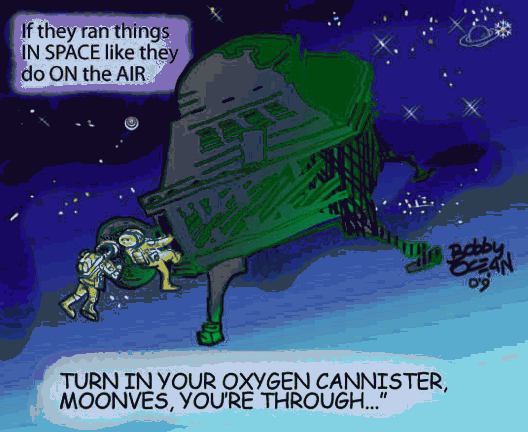
I found one of those strengths in outer space.

Managing

When I worked at XM Satellite Radio, I was one of their few experimental expeditions into allowing a host to originate from other than their studios, then located in Washington D.C. and I was tracking from my studio in California. I did a four-hour, afternoon, all-70s music show, heard from 3 to 7P in California and up through the different time zones to Miami where I was on daily from 6 – 10P.

Working with Lee Abrams and Eric Logan, I put together a different direction for the then disco-leaning all-70s channel. I added the “cosmic,” ingredient to my DJ persona and we were instantly and completely “stone free,” baby. Suddenly, on XM’s pre-set Seven button things weren’t the same for satellite listeners.

Between the music format and comically cosmic Space Jock, the 70s became mentally unstabilized and teetering on the psychedelic edge of logic and creation. – that is, freed from the typecast two-dimensionality of the dance fashions, and liberated from ALL conventional norms.

This took quite some amount of writing — averaged out to 120 liners a week and they had to be carefully written for a national audience. Further, I wanted to sound live, like I was having fun and able to blow a mind every now and then — without alienating people with difficult concepts.

It just came to me that with no staff, I had to create a playbook for myself with a limited quantity of proven moves, a fat set-list of 70s themes and scenarios within which to perform. To that end I devised a series of little formulas containing everything from time travel concepts to Eastern philosophies, all simplified and rendered into one-liners.

To physically write that much material required help, and none other than my own was forthcoming. How did it get done? The process required a small series of steps:

1. Turn on Awareness (get to the center where you “know that you know”).

2. Turn on Understanding (willingness to “go along” cranked open and up. Improvisers do this with their “no blocking” unwritten rule. They always move forward with a premise rather than stop and question it.)

3. Add Music List and station elements (artist, title, genre, story, specific reference lines; Channel-7, XM, special slogans like “Listen Large!” and other channels info); there was no end to cross-plug material;

4. Mix the basic ingredients around a bit to make different flavored drops, get out of the way and let it come.

For three years I kept things comic book simple, even Salvation, worked hard with my techs across the country, had fun, and my channel was always in the top three of all XM channels sampled, always killed the other satellite’s 70s attempt.

I don’t know if a similar thing will happen to you, but, once I turned the writing faucet on to Full Open, and got out of the way, the ensuing stream smashed any ideas I had in place about not being able to do it, and never trickled. The Stones’ Keith Richards was right when he said about writing, “it just comes, I receive it. It’s like…Incoming!”

BTW: No one says you have to turn off the understanding and awareness.

{ 0 comments }

NANCY WOLFSON COACHING VOICEOVERS …WITH RESULTS

voiceover graphic

If until now the only voice acting direction you’ve received is “more energy” or “make it friendlier,” here’s a glimpse of someone with a different perspective.

As a former agent and casting director, Nancy Wolfson’s sole goal is helping the voice actor book the audition. And she’s very, very good at that.

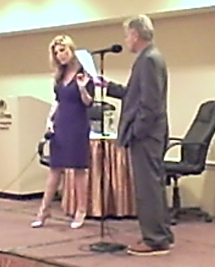
Nancy had never met radio legend Bobby Ocean before he bravely stepped onstage at this year’s International Radio Creative & Voiceover Summit.

Granted, in Bobby she had a lot of talent to work with. Still, her keen ear and psychological insights are remarkable.

As are the results.

If you’d like to learn a lot more of Nancy’s methods for turning “good” performances into “hire that person!” performances, here is where you can download a nearly 3-hour recording of one of her live seminars. (I was there. It was a mind-blowing experience.)

{ 13 comments }

radio advertising graphicA loyal reader uploaded this radio commercial, which “includes an octo-man who is capable of handling several tools at one time.  I’m also wondering if La-Z-Boy is the name of the dude who produced this.”


This radio commercial does so many things wrong, I don’t even know where to begin critiquing it.

So I’ll leave it to you: How many advertising errors can you spot…in this spot?

{ 12 comments }