
≡ Menu

DOES RADIO VOICE TRACKING HAVE TO BE BORING?

radio DJ voice track
A Loyal Reader Writes:

“In addition to my job as Production Director for a station group, I voicetrack a Sunday night shift on a small town station in another market.

“I do this shift for free because the program director is a buddy of mine and I’m just helping him out.

“What can I do to spice up the show a bit?

“This station doesn’t have much to promote because they don’t have the money for big events.

“I can’t do weather, because I’m voicetracking from 100 miles away.

“It gets boring just doing ramps between songs and a pre-break sell.

“Any ideas (keeping in mind that I do this for free, so hours of show prep isn’t what I’m looking for)?”

Even if the radio station doesn’t do big events, presumably they do something on their airwaves.

Your PD friend should make sure you know everything that’s happening at that station, all the staff, and can talk about the station, its programming and its people as though you’re right there.

“It gets boring just doing ramps between songs and a pre-break sell.”

Assuming you know what songs are being played, there’s no limit to how creative you can be in relating to the music — even in a brief time.

“Hours of show prep isn’t what I’m looking for.”

The secret to any good show — live or recorded, paid or unpaid — is show prep.

Your listeners don’t know (or care) that you’re not being paid; you’re the disc jockey on their radio station.

I say this seriously and without any sarcasm or criticism: If the fact that you’re not paid means you can’t afford to do enough prep to deliver a good show, “just say no;” stop doing the show.

{ 23 comments }

First, the radio commercial….

The beginning of a radio commercial should communicate its subject matter — or, at the very least, identify the targeted listener.

But the first 25 seconds of that radio spot is gibberish.

This advertiser is telling us that the future isn’t here yet, huh? What a revelation.

And pointing out that we’re now in the 21st Century? In 2011? By now, “21st Century” has lost most of its novelty value.

Is the commercial message supposed to be about entering the 21st Century? No.

It’s about Wells Fargo’s “Way To Save Savings Account.” It’s “exclusive to Wells Fargo,” which means they’ve trademarked the name.

The commercial message should focus on the results the “Way To Save Savings Account” apparently is designed to deliver:

“We know it can be challenging to add to your savings consistently. That’s why we’ve set it up a program that automatically saves for you….”

Yeah, that’s what the radio commercial was supposed to be about.

As an account holder, I hope Wells Fargo takes better care of my money than it does of its own money that’s been allocated for radio advertising.

{ 3 comments }

The Bobs acapella singing groupCharlotte, North Carolina.

1991.

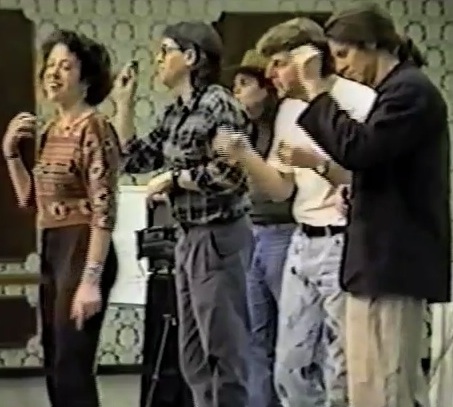
A 3-day Air Personality Plus+ seminar with Ross Brittain, Gary Burbank, and The Greaseman as guest speakers.

You’d think that would’ve been enough, right?

But coincidentally, the phenomenally talented The Bobs were performing that weekend in Charlotte. I conned them into making a surprise appearance at our little radio gathering.

Thanks, The Bobs!

{ 1 comment }

December 1997 (continued):

My final trip of the year took me first to England and then to Germany.

My first stop was Harlow, England, where Paul Chantler had arranged for me to present Air Personality Plus+ for the crew of Essex Radio.

British cooking

Chicken & Chestnut Pie

Upon my arrival, Paul took me out for a very traditional (and tasty) English dinner of chicken & chestnut pie. Suddenly I realized where we Americans get our “pot pie” tradition.

Someone on the 10-hour flight from Los Angeles must’ve had a flu bug (and subsequently shared it with the rest of us passengers), because I awoke the next morning with a terrible, debilitating cough.

I hacked my way through the morning sessions of the seminar and decided to forego lunch in favor of an impromptu visit to a local medical clinic, where a Dr. Singh prescribed some heavy-duty medication for me.

Oddly, when I began the afternoon sessions I already felt much better…even though there hadn’t yet been enough time for the medicine to take effect. I truly think the genuine sympathy and concern I was receiving from the Essex Radio attendees sent some sort of healing message to my soul (and throat).

British restaurants Essex

The Gables

That evening, I accompanied Paul and three of his programme controllers to The Gables, a lovely old, charming restaurant. With the seminar-induced adrenalin supply suddenly shut off, I wasn’t in the best physical condition.

But it nonetheless was a very pleasant way to mark the end of my stay in Essex.

{ 0 comments }

Recently I demonstrated how to take an apparently mundane piece of “trivia” and turn it into an audience-pleasing feature.

The key was to put the information into a fresh, provocative context.

Some radio hosts think that any topic or trivia question is appropriate as long as it’s “topical.”

But not all topical features are relevant.

I’m writing this on Thursday, August 11, 2011. I could ask, “When is the last year that August 11 occurred on a Thursday?”

That would be topical, but who cares?

And not all relevant features are topical.

More importantly, although I have been preaching the virtues of “relevant” programming for my entire career, there is one factor that is even more important than relevance:

Entertainment.

But it’s important to note the definition I assign to “entertainment” in the context of radio:

“Worth listening to (as determined by the listener).”

Relevance is so important only because the more relevant a feature is to someone’s life, the more likely it is that person will listen.

But relevance alone isn’t enough.

If you don’t believe me, try airing a 30-minute lecture on cholesterol levels in 35+ males on a highly rated News/Talk station.

Lots of adult males in that audience, with a topic that’s highly relevant to their lives. But darn few will listen.

The listener judges whether or not something is worth listening to based on a combination of Relevance and Presentation.

The more immediately relevant the information, the less important the presentation.

“Someone is coming to your house right now to try to kill you” — You don’t need much of a fancy set-up there; you’ve got the listener’s attention.

High cholesterol levels are very relevant to the lives of many adult listeners. But few of them perceive it as immediately relevant.

That’s where topicality becomes a factor. “Cholesterol levels in 35+ males” suddenly becomes much more relevant to that target audience when some famous 36-year old athlete drops dead of a heart attack.

Summing Up

Relevant does not always = Interesting.

Topical does not always = Relevant.

But when the two meet and you find an interesting way to share the experience with your listeners, your radio program soars.

{ 0 comments }