≡ Menu

First, listen to the commercial:

Now, what do you remember?

And that’s immediately after you deliberately listened to it. Imagine the impact that advertisement made on consumers who had the radio on at the time but had no reason to stop what they were doing and try to pay attention to it.

They begin by giving us alternate definitions of the word “new” — as though the targeted listener woke up this morning thinking, “Gee, I wonder what ‘new’ really means?” or even “Gee, I wonder what’s new?”

Here’s a line that’s guaranteed to put any listener to sleep: “The youngest and freshest in the Luxury Car class, backed by 125 years of innovation.”

Hint: If you want to sell the idea of “new,” don’t tell people that it’s a continuation of a 125-year old tradition. (Yes, they say “125 years of innovation,” but what sticks with the listener is “125 years,” not “innovation.”)

If you managed to prevent your mind from wandering away from this radio commercial, what’s the one thing that actually sounded interesting?

Right. The “Attention Assist, which can detect and alert drivers if they become drowsy.”

That’s a genuinely interesting feature. Perhaps even — as Mercedes claims — an innovation.

Too bad it was lost among all the meaningless blather, accentuated by blandly irrelevant music.

Oh, one more thing.

This radio commercial aired on July 24. Yet it attempts to tie Mercedes’ alleged innovation to the “New Year” of 2011.

{ 7 comments }

(video) IMPROVISATIONAL COMEDY AT ITS FINEST

If you’re unfamiliar with Mike Nichols & Elaine May….

This sketch evolved out of improvisations they performed at Chicago’s Compass Theater (the forerunner of Second City).

And if you’re not sure of the chronologically: Yes, Elaine May made this character famous years before Lily Tomlin came along. I’m just sayin’…

{ 0 comments }

December 1997 (continued):

After surviving a sudden flu attack in Essex, England, I flew to Hamburg, Germany.

After collecting my luggage at the airport, I found myself stymied by an escalator that was motionless. Yes, I could have walked up the motionless escalator, but to do so while pulling my luggage cart behind me would have proven difficult.

I looked around in vain for an elevator and then, resignedly, trudged to an airport information counter and said, “The escalator seems to be broken. How do I get upstairs?”

“No, it’s not broken,” I was told. “Just step onto it, and it will begin to move.”

An escalator that moves only when someone steps onto it? Makes perfect sense, and by now I’m sure you’ve experienced at least one of those, too. But at the time, I’d never heard of one.

After solving the mystery of the non-moving escalator, I made my way to arriving passengers’ greeting area, where Delta Radio’s Maren Hasenpath was waiting to drive me on the hour’s journey to the town of Kiel. (This was a return visit to Delta Radio, arranged by Adam Hahne.)

Checking into the Hotel Berliner Hof that evening, I discovered to my dismay that the hotel did not have a restaurant. So I bundled up and braved the bitterly cold Kiel winter evening, looking for a place to eat.

Wait: When I say “bitterly cold,” what I mean is:

This might have been the single coldest evening I’ve ever experienced. I do not recommend vacationing in Kiel in December.

The only place I could find whose menu I could interpret was, alas, a McDonald’s.

McDonalds resaurant germany

My perfect evening was capped off by several frustrating hours in my hotel room, trying unsuccessfully to connect to *Compuserve (for some reason always a challenge in Germany).

*Remember Compuserve? Remember “dial-up”?

The following morning I worked with Delta Radio’s morning show; after lunch I presented Power Phones to the entire air staff.

Then it was back to Hamburg, where I spent another evening in another hotel swearing at Compuserve and the German telephone system.

At the instigation of Ina Tenz, the programming staffs of FFN, Radio Hamburg, and Antenne MV met the following day for my Air Personality Plus+ seminar.

At the end of the day, Rick Demarest gave me a ride back to Hamburg Airport; I flew to London, spent the night at an airport hotel, and flew back home the following day…just in time to unpack and then pack again for the annual family trip to Connecticut for the holidays.

{ 0 comments }

WHAT TO DO ABOUT TERRIBLE FELLOW RADIO DJ?

A Loyal Reader Writes:

“The afternoon jock at our station is terrible! The worst air talent I have ever heard. Her ratings are in the toilet, she is mean to listeners (that’s if she even picks up the phone), she does no show prep (does it count as show prep if you do it in the middle of your airshift?), and during her shift she shops for things online.

“I know that my PD is aware of her ‘awfullness,’ but he’s not doing anything about it. He keeps telling me that things are going to change soon. It’s been about six months, and nothing has happened!

“I’m tired of taking phone calls from listeners telling me that she is terrible. I’m getting sick of people on the street telling me that they can’t listen to the station between the hours of 2pm and 6pm! What do I do? Keep my mouth shut and just do my job?”

If you play your cards wrong, one day you’ll become a program director and then you’ll have to worry about jocks who do a lousy job.

Until then, enjoy the freedom to concentrate only on your own radio program and your own performance.

I will add, however, that if I were a PD whose jock was spending her on-air time shopping online, I would give that jock one warning and then fire her if she did it again.

{ 0 comments }
radio commercials copywriting

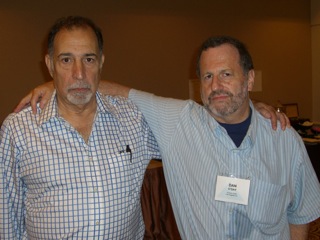
Dick Orkin & Dan O'Day Share A Laugh

This is the third installment in a series that began with Dick Orkin repeatedly hearing this refrain from radio station salespeople:

“I don’t like writing commercials!”

Dick surveyed a large number of radio account executives to determine their most common reasons for viewing “commercial copywriting” negatively.

One of the common answers was:

“I have no talent and everything I come up with is boring.”

You do not need talent to write an effective commercial.

You do need product knowledge (which you can attain) — an understanding of how advertising in general and radio advertising in particular work — and a genuine desire to help your client.

If you’ve been brainwashed into believing your job exists solely to provide income for your employer, either get your brain dirty again or go find some other job where not caring about the results you produce will be less important. (“Big deal, so I didn’t get that pickle exactly in the middle of that Big Mac.”)

{ 0 comments }