≡ Menu

RADIO STATIONS THAT SAY “COME PICK UP YOUR PRIZE”

A Loyal Reader Writes:

“I think I know the answer, but I would like to know how you feel about making listeners pick up prizes.

“I’m talking about movie passes. Not CD’s that could be broken in the mail or concert tickets that could be lost.

“Our manager insists we have all winners who live within the city limits pick up all prizes.”

I’ve addressed this at length before.

Having listeners pick up prizes — not only movie passes but also CD’s, tickets, etc. — does the following:

• Makes the station seem cheap.

• Makes the station seem petty.

• Makes clear that the station doesn’t care about the winners.

• Takes an exciting an event in the listener’s life — winning a radio contest — and turns it into a chore.

How many stations are so shortsighted as to make their listeners pick up their prizes?

Almost all of them.

The fact that so many stations act so foolishly doesn’t make it right. It just makes it commonly foolish.

Years ago a program director told me his radio station’s general manager justified the practice by saying, “Heck, people don’t even bother to pick up 90% of the prizes we give away anyway!”

Ummm….Yeah. You’re giving away prizes that people don’t want enough to expend the time and energy required to come to your station “during normal business hours” and pick them up.

The fact that people don’t pick up their prizes is not evidence that you’re doing something right.
radio station prizes promotions

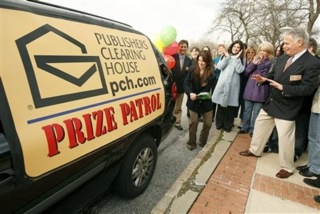
Bottom Line: If I win $10,000,000 in the Publishers Clearinghouse Sweepstakes, they come to my house to deliver the check.

But I’m supposed to sacrifice an hour of my life to come to your station and pick up two tickets to the local boat show — which otherwise sell for $2 each?

Sorry, no.

If you can’t make winning a radio contest an exciting, enjoyable experience from start to finish, keep your stupid prizes and play another record instead.

{ 18 comments }

First, the commercial….

This Trader Joe’s commercial has an interesting story to sell with. But the copywriter didn’t structure it well.

The opening line is very strong. It paces the common experience of the targeted listener:

“It’s almost Thanksgiving. And that means turkey, stuffing…

…and Aebleskiver.”

Huh? We weren’t expecting “Aebleskiver.” What’s that?

That question isn’t answered until 28 seconds later — by which time the targeted listener no longer is paying attention.

During those 28 seconds, the advertiser talks about:

  • Breakfast
  • The name of the guy who is speaking
  • Turkey & trimmings
  • Breakfast foods
  • Turkey
  • Pie
  • Football
  • Cereal & juice
  • Eggs & bacon

And then, finally, they return to what originally had captured the listener’s attention: Aebleskiver.

Trader Joe's radio commercial

Aebleskiver

Too bad that by this time, the listener has become a former listener.

Here’s a quick & dirty edit to demonstrate how this story could have succeeded.

Do you hear how, in that incomplete version, the story moves smoothly?

They do a good job of helping us envision the product, both at the breakfast table (“like a golf ball”) and in the story (“We’re selling each bag of about 20 Danish pancakes for about $3.49”).

Hmmm…. Not bad for 20 Danish pancakes. We can picture the bag, and we can picture where in the store we can find it: in the frozen foods section.

But we can picture the product only if the radio commercial is structured in way that makes use of the “story” to attract and hold our attention.

{ 6 comments }

"The Music Box"

This clip is nearly 80 years old.

It’ll still be funny 80 years from now.

And people still will be watching and laughing.

{ 2 comments }

We’ve devoted enough space on this blog recently to the importance of a radio host identifying himself/herself frequently, out of respect for and for the comfort of the listener.

But tonight I was on the audience end of this equation, and it confirmed what I’ve been preaching (and preaching).

I went to a screening of THE DESCENDANTS, and afterward there was a Q&A session with the two screenwriters and the film’s director.

Oh, and there was a moderator. He introduced Writer #1. He introduced Writer #2. And then he introduced the director.

But he didn’t tell the audience who he was. Based on a couple of comments I overheard as I left the theater, I wasn’t the only one who found that annoying.

Why didn’t he introduce himself? It has to be one of three reasons:

  1. He figures he’s so important that everyone in the audience must know who he is. (If so, he’s mistaken.)
  2. He doesn’t know better.
  3. He does know better, but this time he forgot to introduce himself.

I’m guessing it was Reason #2.

He avoided the kinds of smug, “look what an insider I am” moderator questions that usually dampen such post-screening sessions. So it’s probably not Reason #1.

Anyone who does lots of public speaking knows even “good” speakers make mistakes, forget obvious points, etc. That can include forgetting introduce oneself to the audience. But that particular lapse is pretty rare, so I’m ruling out Reason #3.

But whatever the reason was, it made some audience members uncomfortable and detracted from their enjoyment of the discussion.

On the other hand, it’s an excellent film and I highly recommend it…

Spoiler Alert: Don’t watch the longer trailers for this film, because they give away an important plot point. You’ll enjoy the movie a lot more if you don’t know this particular twist is coming.

{ 4 comments }

THE MOST COMMON RADIO TALK SHOW HOST ERROR?

radio talk show consultant

Holland Cooke

I’ve been saying this for years.

Every time I hear a talk show host doing this, I just shake my head in sorrowful bewilderment.

So I was very happy to see my apparently minority view reinforced by News/Talk consultant Holland Cooke in this a piece he wrote a while ago.

RADIO TALK HOSTS: DON’T ALLUDE TO CALLERS ON HOLD

by Holland Cooke

This might be the most common wrong signal that hosts unconsciously send listeners:

“Frank from Springfield, thanks for holding on through the break.”

Polite and well-intentioned, but what’s the message? That callers have to sit on hold during several minutes of commercials? Forget it! The station should work to the listener’s convenience.

This may seem like a nuance on our side of the microphone, but it’s more apparent out there. If you’re worried about callers-already-on-hold hanging up, have the screener assure them off-air.

{ 8 comments }