It’s Thanksgiving in the U.S., and between the turkey and the football not many people will visit this blog today.
If I write about radio, six people will read this.
And I don’t want to write one of those “I’m thankful for…” essays.
But somehow it seems natural to share with you two powerful musical performances. There’s a good chance you’ve seen one or both of them, along with millions of others on YouTube.
Still….
I thought John Cale had the definitive version of this Leonard Cohen song until I witnessed kd Lang’s performance.
Not saying one is better. Just different.
Cale’s is mournful. Lang’s is anguished.
I will say, though, that I had a better understanding of what the song’s about after hearing Lang.
Anyway…Happy Thanksgiving, my radio brethren around the world.
Predictably, yesterday’s blog post unleashed a firestorm of responses — some agreeing with me, others vehemently disagreeing.
To the people who talked about the excitement of visiting the radio station and meeting the DJs: It can be exciting if doing so is the listener’s choice. But forcing them to come to the station? Bad idea.
For every radio person who fondly remembers going to the local radio station and meeting some superstar air personality, there are a thousand other people who went to the local radio station and met…
The receptionist?
A bored Promotions Assistant who hasn’t been taught how to receive customers (i.e., listeners) graciously and enthusiastically?
Some anonymous employee who said, “Oh, the person who handles that isn’t here right now. You’ll have to come back later”?
I’ll never forget a station in Indiana that gave a lucky winner two lottery tickets…which had to be picked up at the radio station, during normal business hours.
I thought, “Wow! In Indiana, lottery tickets must sell for 20 or 30 dollars each! Certainly they wouldn’t expect a listener to invest the time to drive downtown during a business day to pick up a prize that has a projected value of 37 cents!”
Radio station managers who object to mailing such prizes invariably offer one of two reasons:
One is: “Yeah, but if we mail out those prizes, that postage will add up.”
The other is: “What if they say they never received the prize?”
The answer to “the postage adds up” is:
“Yes, most things do. This is an important promotional expense. If you are not prepared to make the experience you are offering your listener as positive and enjoyable as possible — if you are not prepared to do it in a way that makes the listener want to keep listening to your station — then perhaps you shouldn’t be doing that promotion or contest in the first place.”
If you truly are worried that listeners will falsely claim not to have received their prizes, use a delivery service that requires a signature upon receipt. This can be the Post Office’s Certified Mail; it can be United Parcel Service; it can be a courier service.
Managers can rationalize this issue all they want, but here is how listeners view it. This is a listener calling into the legendary John Landecker’s radio show, many years ago at WLS in Chicago:
(Nice touch, John’s delayed completion of the sibilance on “evidence.”)
Perhaps that listener doesn’t sound like the most articulate person in the world, but he represents the mass audience. He has compared a station that makes winners come pick up their prizes to one that mails the prizes…and the the first station looks cheap, foolish and inconsiderate by comparison.
Station managers who aren’t able to budget for postage to mail or otherwise deliver prizes should ask themselves:
“Why are we giving away prizes?”
“Because that’s what radio stations do” — Wrong answer.
“Because clients want us to” — “Clients” suggests they’re paying you, right? Fine. Build the cost of prize delivery into the package the client buys.
“Because we want to enhance the relationship we have with our listeners” — Right answer.
If you can’t deliver the prize in a way that makes the winner go “Wow!” — or at least doesn’t make the listener go, “Good grief, what a hassle,” then stop giving away prizes.
Here is a very simple idea that enables everyone to come out ahead:
Arrange a trade with a local courier service. All mid-to-large cities have such services, but few if any have a budget for radio advertising.
Do a little research and pick the best, most efficient, most professional, and friendliest service in town and present them with your proposition:
They will deliver to all of your local prize winners, treating each delivery just as they would any other order.
At the end of a typical broadcast day, someone from your promotion department will call the courier service to place the order for the following day’s pick-up…using the list of that day’s winners. The next morning they pick up those prizes and by the end of the afternoon they deliver them.
You do not give up commercial inventory as part of this deal. In exchange, you give an on-air mention every time you award a prize:
“Congratulations, Janie! You’ve won dinner for two at Emilio’s Restaurant. ABC Courier Service will deliver your dinner certificate right to your door tomorrow….”
That’s the easiest “sale” you’ll make all year. But, sadly, few radio managers will make the small, one-time effort to establish a system for getting their most loyal listeners to say, “Wow!”
“I think I know the answer, but I would like to know how you feel about making listeners pick up prizes.
“I’m talking about movie passes. Not CD’s that could be broken in the mail or concert tickets that could be lost.
“Our manager insists we have all winners who live within the city limits pick up all prizes.”
I’ve addressed this at length before.
Having listeners pick up prizes — not only movie passes but also CD’s, tickets, etc. — does the following:
• Makes the station seem cheap.
• Makes the station seem petty.
• Makes clear that the station doesn’t care about the winners.
• Takes an exciting an event in the listener’s life — winning a radio contest — and turns it into a chore.
How many stations are so shortsighted as to make their listeners pick up their prizes?
Almost all of them.
The fact that so many stations act so foolishly doesn’t make it right. It just makes it commonly foolish.
Years ago a program director told me his radio station’s general manager justified the practice by saying, “Heck, people don’t even bother to pick up 90% of the prizes we give away anyway!”
Ummm….Yeah. You’re giving away prizes that people don’t want enough to expend the time and energy required to come to your station “during normal business hours” and pick them up.
The fact that people don’t pick up their prizes is not evidence that you’re doing something right.
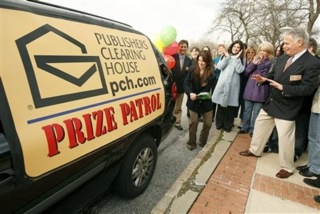
Bottom Line: If I win $10,000,000 in the Publishers Clearinghouse Sweepstakes, they come to my house to deliver the check.
But I’m supposed to sacrifice an hour of my life to come to your station and pick up two tickets to the local boat show — which otherwise sell for $2 each?
Sorry, no.
If you can’t make winning a radio contest an exciting, enjoyable experience from start to finish, keep your stupid prizes and play another record instead.
This Trader Joe’s commercial has an interesting story to sell with. But the copywriter didn’t structure it well.
The opening line is very strong. It paces the common experience of the targeted listener:
“It’s almost Thanksgiving. And that means turkey, stuffing…
…and Aebleskiver.”
Huh? We weren’t expecting “Aebleskiver.” What’s that?
That question isn’t answered until 28 seconds later — by which time the targeted listener no longer is paying attention.
During those 28 seconds, the advertiser talks about:
Breakfast
The name of the guy who is speaking
Turkey & trimmings
Breakfast foods
Turkey
Pie
Football
Cereal & juice
Eggs & bacon
And then, finally, they return to what originally had captured the listener’s attention: Aebleskiver.
Aebleskiver
Too bad that by this time, the listener has become a former listener.
Here’s a quick & dirty edit to demonstrate how this story could have succeeded.
Do you hear how, in that incomplete version, the story moves smoothly?
They do a good job of helping us envision the product, both at the breakfast table (“like a golf ball”) and in the story (“We’re selling each bag of about 20 Danish pancakes for about $3.49”).
Hmmm…. Not bad for 20 Danish pancakes. We can picture the bag, and we can picture where in the store we can find it: in the frozen foods section.
But we can picture the product only if the radio commercial is structured in way that makes use of the “story” to attract and hold our attention.