November, 1995: My last trip of 1995 was to Barcelona, Spain, where I spoke on Managing Personality Radio and Building A Winning Morning Show at the NAB’s European Radio Operations Seminar.
The plan was to fly KLM from Los Angeles (LAX) to Amsterdam and then connect to Barcelona. My flight was scheduled to leave L.A. at 4:20PM.
Back in those pre-9/11 days, in the U.S. for international flights you were supposed to arrive at the airport two hours before flight time.
Usually, though, I got there 90 minutes early. But there was a big security alert at the airport, and I figured I’d play it safe by arriving there a full two hours before departure.
So I hopped onto the 405 Freeway to get from my house to LAX. With little traffic, this is a 12-minute drive. With normal traffic it takes 25 minutes.
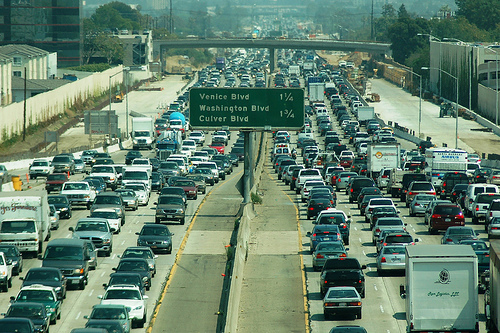
This traffic, however, was neither slight nor normal. It was a bumper-to-bumper crawl. If I stayed on the 405, it would take me at least an hour.
Fortunately, I am familiar with the inside driving tricks known only to Angelos. One of those tricks is — in a situation like this — to exit the 405 and take Sepulveda Boulevard, which parallels the freeway.
Sepulveda is a large, four-lane thoroughfare, and there could be no reason for it to move slowly at that time of day.
Unless, of course, Sepulveda Boulevard was under construction.
It was.
I arrived at LAX 55 minutes before the departure time. Closer than I would have liked, but still enough time for me to check my suitcase and get a boarding pass.
“Your flight to Amsterdam will experience a slight delay,” said the ticket agent. “Would you like to use our International World Class Lounge while you’re waiting?”
A delay? Well, no reason to worry. Amsterdam is KLM’s hub, and as long as they got me to Amsterdam I wouldn’t have any trouble finding a flight to Barcelona … even if I missed my originally scheduled connecting flight.
So I trundled up to the KLM lounge, snuck some packaged cookie treats into my tote bag (uh, y’know, in case I encountered any desperately hungry people), had a Diet Coke, and then looked at the computer screen that displayed the departure status of various KLM flights.
Next to mine it simply said, “Delayed.”
I inquired at the lounge’s service desk. “Just a minor equipment problem,” I was told.
Thirty minutes later an announcement was made for the assembled, mildly anxious travellers:
“Ladies and gentleman, the aircraft that will be flying you to Amsterdam has been delayed, due to a bird strike that occurred while it was flying here from Amsterdam.”
I have heard of pilots striking, also flight attendants. And cleaning crews and baggage handlers. Birds on strike, however, was new to me.
As everyone stood around scratching their heads as they tried to assimilate this message, I cleared my throat and asked, “Um….By any chance is a ‘bird strike’ what you call it when a bird gets sucked into a jet engine?”
“Yes, of course,” replied the KLM representative.
I resisted the temptation to say, “Yes, of course. Now please tell everyone here what a stop set is, and then perhaps you could explain what is meant by vertical and horizontal music rotation.”
So some birds got sucked into an engine. Very sad.
And our plane will be landing….When?
“Ah,” she said. “That is very hard to say.”
And why is it hard to say?
“It had to return to Schipol for repairs.”
In other words, our plane was still at the airport in Amsterdam….a 10 1/2 flight from L.A.
Still no need to worry; KLM explained they had another aircraft we could use. Our luggage was being loaded onto that craft even as we spoke, and we should be able to take off around 5:30.
And, of course, there still were lots of connecting flights available from Amsterdam to Barcelona.
At 4:45PM there was a new announcement: The replacement plane had a small problem. A part needed to be repaired or replaced. It was being worked on, and we probably would leave at 7:00.
If, that is, they could fix the problem.
Now I started to worry. If this flight was canceled completely, there would not be another KLM flight to Europe until the following morning. That would mean checking into a hotel near the airport for the night. And by the time I made my connection in Amsterdam and arrived in Barcelona, it would be quite late on the Saturday night before I was scheduled to speak.
(My plan had been to arrive in Spain on Saturday morning.)
Perhaps, I thought, I should explore the possibility of taking another airline. I checked the Official Airline Guide and saw there was a British Airways flight leaving LAX at 5:15 for London, from where I could connect to Barcelona. So I went to the service counter to see if they could secure a seat for me.
The man in front of me in line at the service desk had the same idea. And he was given the last available seat on that B.A. flight.
“No Business Class seats?” I asked. “Well, how about a coach class seat? Being uncomfortable during the flight is better than missing my engagement.”
“I’m sorry, sir. The entire flight is completely sold out.”
“Completely??”
“Actually, it is overbooked. There is no way to get you on that flight.”
“When,” I asked, “is the next KLM flight to Amsterdam?”
“10 o’clock tomorrow morning.”
That still should manage to get me to Spain…barely.
“All right,” I sighed, “let’s get me a seat on that flight in case tonight’s gets cancelled.”
“I’m very sorry, sir, but that flight is completely sold out, too. There is a long waitlist.”
I stared at her. Silent, just staring.
I continued to stare.
And KLM’s next flight to Amsterdam? Late the following afternoon. Too late for me to reach Barcelona in time.
Back to my OAG, where I discovered another British Airways flight leaving for London at 9:15 that evening. KLM kindly grabbed a seat for me on the B.A. flight. But they were pretty sure we’d all be able to leave on our delayed KLM flight instead.
At 6:45, we were told the new hoped-for departure time was 10:00.
You see, they had an aircraft. But an engine fan was broken, they couldn’t fix it … and it never had occurred to KLM to have spare parts at LAX. So they were trying to borrow a part from somewhere.
By now I knew that KLM flight was not leaving that night. I had checked a suitcase with KLM; could they deliver it to B.A. for the flight I had been booked on?
No, they couldn’t.
They would have to take it off the airplane and bring it to Baggage Claim … where I would claim it and lug it to the International Terminal … a mere 15-minute stroll.
Okay. Unload my bag, please.
The KLM agent made a phone call and was told, “We’ve already loaded the bags onto the plane, and we can’t take any off.”
Translation: They didn’t want to go through the extra work of finding and removing my suitcase.
I told the agent this was not a satisfactory response. She called the baggage people once more and was told the crew could not open the door to the cargo hold. The door, it seems, was “stuck.”
While I am waiting for KLM’s engineers to figure out how to open the door, she said, perhaps I would like to use a $15 KLM voucher to have dinner in the airport?
Sure. Why not.
Of course, the restaurant told me the voucher was not good for $15; it had an $11 maximum.
So I got a sandwich and a beverage and then kept adding chocolate cookies until the total reached $10.99. (I told you, they’re for desperately hungry people I might encounter during my journey. Why is that so hard to believe?)
I returned to the KLM lounge at 7:30. I was told they still couldn’t get the door to the cargo hold open. Now I was getting upset.
I wasn’t the only passenger who was complaining; this one guy was loudly demanding that they return his baggage to him. He appeared to be mid-eastern — Israeli or Iranian, I thought — and he, too, had been rebooked onto that B.A. flight.
I didn’t like him much; I didn’t think it was necessary to be so confrontational with the KLM agent. Fearing he would alienate the staff so much that no one would have their luggage retrieved, I stepped in and acted the role of a somewhat more moderate yet upset customer…kind of a “good cop/bad cop” combination.
At 7:50 we were told, “Your baggage will be downstairs in 10 minutes.”
So the Israeli guy (as it turned out) and I both rushed to the baggage claim area. If our bags were available at 8:00, we would have 1 hour and 15 minutes to drag them to the International Terminal, go through Customs and Security, get to the gate. That should be enough time.
The bags were not there in 10 minutes.
They were not there in 30 minutes.
Forty minutes later, at 8:30, they still were not there.
After persistent protests to the baggage claim representative, he managed to get his supervisor on the phone…who told him none of the bags had been unloaded and that it would take at least another 30 minutes.
That would be 9:00 — 15 minutes before the British Airways flight would leave. No way to get the bags and make the flight.
But we both waited a little longer.
At 8:45 I gave up, grabbed my carry-on items and began running to the International Terminal. The Israeli guy stayed behind, determined to get his luggage.
Breathless, perspiring heavily, with my lungs feeling as though they were on fire, I made it to the B.A. counter at 9:00. I handed them the ticket KLM had given me for the B.A. flight … and there was no record of it in their computer.
And the flight was oversold. Not only were there no available seats, they were going to have to turn away people who already had bought tickets.
So, what does one do now? Here are the choices:
A) Scream and yell and try to make such a commotion that they will put me on the plane just to get me away from the ticket counter.
B) Tell them I am desperate and throw myself on their mercy.
C) Give up, go home, and — because there absolutely was no other flight that could deliver me to Barcelona in time — hope that Randi Reiten and Lucy Smith at the NAB would understand.
I chose “B.”
With 100% sincere desperation, I said, “Look, I already have had one flight canceled on me. This is the only remaining flight that can get me to to Europe by tomorrow. If I am not in Barcelona tomorrow evening, a lot of people will be very, very angry at me. I was there when KLM called you to reserve my seat. You have the ticket right there. I don’t know it doesn’t seem to be in your computer, but I have to be on that plane.”
Somehow the agent either found or forced my reservation onto the computer. I had my seat. I thanked her profusely and then ran through Customs and Security. I collapsed into my airline seat at 9:15PM.
It was obvious I wouldn’t see my luggage for a few days. Maybe I could buy some clothes in Barcelona. But at least I would be able to honor my commitment.
Five minutes later they were about to close the door to the jetway when another passenger ran onto the plane.
It was the Israeli guy, carrying his suitcase.
And mine.
He had convinced United’s baggage claim department to release my luggage to him, as well as his own. And he ran all the way with both of our bags.
Suddenly, I realized I kind of liked that guy.
 Perhaps my favorite radio convention moment ever: The Country Radio Seminar, 1991.