March, 1993: I began the month with my fifth appearance at the Country Radio Seminar in Nashville, where I conducted a special half-day radio programming seminar (Power Phones and Radio Self-Promotion: How To Manipulate the Media).
The most memorable moments came when all of the electricity in the mammoth Opryland Hotel went out…for a couple of hours. (Later I heard an automobile had smashed into a nearby power line.)
Fortunately, just moments before I had finished changing my clothes; otherwise, I would have been stuck in my underwear in my pitch-black hotel room until the lights went back on.
Now the truth can be told: I ghost-wrote a joke for R&R’s Erica Farber, who was about to address the attendees. MTV’s Unplugged still was new, so I whispered to Erica, “Welcome to CRS Unplugged.” Huge laughs when she delivered that line to the audience. And I got none of the credit.

The highlight probably was Dolly Parton’s terrific concert performance. This was the first time I’d seen her, and after 25 years of performing I expected a highly polished yet lifeless show. The enthusiasm and energy which infused her performance serve as an inspiration to radio & tv performers everywhere.
Two weeks later I conducted The Psychology Of Management in Toronto for Canada’s Music Industry Conference (now known as Canadian Music Week). This was the first year the MIC featured an exhibit hall, and word-of-mouth response seemed strong enough to suggest they’d do it next year, too…but bigger. By now, of course, CMW has become a huge event.
April, 1993: Although I’ve worked with the NAB on several occasions, this was my first speaking appearance at the huge Spring Convention in Las Vegas. Proud new father John David and Susan Platt asked me to create a new, 90-minute session entitled What Every Radio Station Manager Should Know About Programming.
May, 2003: I spent the first week of May in Stockholm, where I conducted a series of four seminars (2 programming, one management, one commercial copywriting) for Anne Chaabane of Swedish Local Radio. Sweden’s very first paid commercials aired April 1, so there was a very strong interest in the techniques of writing powerful radio spots.
This was my first visit to Sweden, and I fell in love with the country. The weather was postcard-perfect (even though everyone kept telling me it’s usually much colder that time of year). Stockholm is a great city for walking around (my favorite tourist activity).
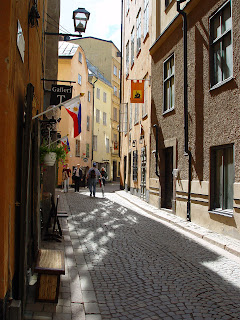
Strolling around Gamla Stan (Old Town) — with homes & shops that have been in continuous use for 300-400 years — was wonderful. The people are very friendly in Stockholm, and everyone speaks English.
Although America is popular with Sweden, you might think otherwise from a great sign I saw outside a Gamla Stan restaurant. The entire menu was printed only in Swedish, but taped to the window were the following English words:
“DON’T COME IN HERE! WE DON’T HAVE ANY KETCHUP!”
My strongest memory, however, is of a visit to the Vasa Museum. In 1628, the largest and most expensive battleship in the history of the world — the Vasa — was launched in Stockholm harbor. (Sweden was at war with Poland at the time.) All of Stockholm gathered to witness its maiden voyage.
Twenty minutes later, a gust of wind appeared, the ship listed to one side, water rushed in the open gun port holes, and with frightening speed the Vasa sank to the bottom of the harbor. This was a huge embarrassment for Sweden and its king.
An inquest was held to assign blame. When it became apparent that the two people most responsible for the debacle were the King and his right-hand man, no verdict was rendered, and the Vasa eventually (and deliberately) was forgotten.
In 1951, a Swedish researcher learned of the Vasa’s sinking, and he decided to look for it. Five years later, he found it. Due to the harbor’s frigid waters and peculiar lack of woodworms, the ship had lain virtually intact for over 300 years. After five years of work and preparation, in 1961 they raised the Vasa …and towed it up the harbor on its own keel.

It’s the only complete battleship from the 17th Century, and it’s in exquisite condition. (Until it was raised, historians weren’t even sure what 17th Century battleships looked like.)
For two years after raising it, the ship’s curators continuously sprayed it with water to keep it from crumbling. Gradually they replaced the water with a preservative, and after 40 years there’s no sign of deterioration.
The Vasa is three stories high, and it’s housed in a wonderful museum that already has attracted millions of visitors.
Trust me: Visiting Gamla Stan and seeing the Vasa are worth a trip to Stockholm. (If you’re thinking about going — it’s beautiful there in summer — feel free to call me for tips on air travel, hotels, customs…and even how to say “hello” and “thanks” in Swedish.)
After a week at home, catching up on mail and phone calls, I made a quick but enjoyable trip to Kalamazoo, Michigan, to conduct Air Personality Plus+ for WRKR. WRKR’s president, Ed Sackley, had attended my NAB convention session and booked me on the spot; just one month later I had the pleasure of working with his air staff. (He also gave me a VERY classy station t-shirt — perhaps the most impressive I’ve seen.)