Illustration © 2009 by Bobby Ocean
The current issue of my Radio Programming Letter discusses some of the challenges of working with a morning show partner and also presents my deconstruction of most programmers’ fallacious conception of “forward momentum.”
This post is for my subscribers to use to add their own comments, thoughts, objections, examples, etc.
 I saw this on my friend Ken Levine‘s blog and was inspired to…Uh, I mean it made me think…
Okay, fine, I’m ripping it off from Ken’s blog. I did save his life in ’Nam at least once, so I think I’m entitled.
May, 1995 (continued): Despite the amount of traveling I do, I never run into people I know in airports…at least, not in the U.S. But while browsing among the gift shop stalls in the airport at Bogotá, Colombia (where I was awaiting my flight back to Los Angeles and where I purchased the deteriorating leather wallet I still insist on using), a voice behind me said, “Hello, Dan!”
I turned to see the smiling face of Radio Express’ Barbara Rounds. (She, too, lives in L.A., but I’ve never bumped into her there.)
Here is the security process I went through upon entering the Bogotá airport that morning:
1. Before I was allowed to enter the airport from the sidewalk, I had to be frisked by a soldier. (I believe that’s the first time I’d ever been frisked.)
2. Before I was allowed to approach the ticket counter, all of my belongings were scanned by an x-ray machine.
3. After checking in at the ticket counter, I went through Immigration.
4. After Immigration, before I could reach my gate my carry-on luggage was x-rayed (again).

Extra Strength Excedrin
5. Before I was allowed to enter the jetway to board the plane, I stood in a fairly long line to have my carry-on luggage opened and the contents examined by a police officer. My bottle of Extra-Strength Excedrin aroused his suspicion, and an intense conference with two of his colleagues followed.
One of them gave me a long, hard stare — obviously with the intent of intimidating me. I, however, am too stupid to be intimidated, so I simply returned his glare.
6. After passing this inspection, I handed my boarding pass to a gate agent, who waved me on toward the jetway.
7. Just a few feet inside the jetway was a female police officer, who frisked me (again!). This was not an altogether unpleasant experience.
Next Week: A quickie French lesson on an international flight.
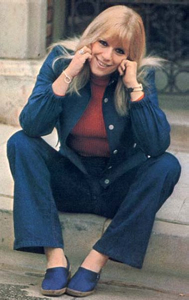
Ellie Greenwich
I’m not going to write a tribute to Ellie Greenwich, because I don’t know enough about her or her body of work to do justice to either.
I do, however, know more about her music than the idiot pop critic for my local newspaper, who implies that “Leader of the Pack” is a great song (it was a big hit but virtually a novelty record due to its way over the top production & performance) while dismissing “And Then He Kissed Me” as “light as a cotton.”
Ask a woman who was 13 to 16 years old when “And Then He Kissed Me” was a hit how important that song was to her.
And what song did that pop critic dummy omit entirely in her recounting of Greenwich’s career highlights? Only the one that truly is iconic of ’60s pop: “Da Doo Ron Ron.”
The Simpsons’ Matt Groening is right: There is no lower form of intelligence than a pop music critic.
But that’s not what I want to talk about.
I’m here today to publicly thank Ellie Greenwich for not suing me.
In 2002, the Enron scandal broke. As I read about all those people whose lives were ruined by greedy, thieving bastards who would do anything to obtain and keep their private jets and multiple mansions, I became infuriated. Livid. Filled with rage.
When you’re a writer, being filled with rage often is not a bad thing. Me, I had to say something. Even if I didn’t have an audience.
The idea popped into my head, I wrote it on a scrap of paper on Saturday, produced it on Sunday, and made it available to my Radio Programming Letter subscribers and website visitors on Monday.
I used “Da Doo Ron Ron” as the framework. Note that I didn’t say “parody,” because it’s not a parody. Making and distributing the recording violated copyright law — no question.
Huh? Don’t radio people do that all the time?
Yeah, and most of the time they’re violating someone’s copyright.
Here’s the short version: To qualify as a parody under the “Fair Use” doctrine, the new work must directly comment on either the original work or on the artist(s) who created the original work.
My little protest didn’t comment on “Da Doo Ron Ron,” The Crystals, or the songwriting team of Barry & Greenwich. (Phil Spector, slimy even then, produced the record and demanded a songwriting credit, so he’s officially listed as a co-writer.) I don’t care what you’ve been told; it’s a copyright violation. Trust me. I actually wrote the book about that topic.
A short time later, a friend of mine began collaborating with Ellie Greenwich on a theatrical project. He played my little rip-off for her. I was told, to my great relief, that when she heard it she laughed.
As far as I know her co-writer and former husband, Jeff Barry, never heard it. But he was a special guest at one of my PD Grad Schools, a really nice guy, and…He’d never hear it anyway.
Thanks for the great (and good and, occasionally, lightweight but fun) songs, Ellie & Jeff.
Meanwhile, here’s the little ditty that Ellie was kind enough to not sue me for.