≡ Menu

November (1995) (continued): As you’ll recall from last week’s exciting episode, I barely managed to get on a British Airways flight to London after my KLM flight to Amsterdam was canceled in Los Angeles.

Upon arriving at London’s Heathrow Airport, I had five hours to kill before my connecting flight to Barcelona, Spain. I went to B.A.’s World Club Lounge and noticed a sign that said, “Showers.”

In my experience, 11 hours on an airplane make a shower seem quite inviting. Plus, it would help kill some time. (I am infamous for taking long showers.)

The showers were up set up a la cabañas, each with an outer dressing area that connects to private shower.

It was very nice. Felt luxurious. Decadent.

And, of course, it made me think of that scene from that movie.

The scene I always think of when I’m on an airline and I go to the restroom and wash my face and, sometimes, even brush my teeth.

Remember THE HUSTLER? Paul Newman has spent 24 hours beating Jackie Gleason at billiards. It’s the game of his life, and Newman can’t be beat.

They take a brief break. Gleason goes over to a wash basin, carefully washes his face & hands, combs his hair, turns back to Newman and says, “Alright, Fast Eddie, let’s play some pool.”

As I exited my private shower cabaña I muttered to no one in particular, “Alright, fast Eddie, let’s play some pool!”

(This led to my being detained by airport security for the next few hours, but that’s not really the point of this story.)

I couldn’t find a clip of that scene, but here’s the moment the two characters first meet…

{ 1 comment }

USING MUSIC IN RADIO COMMERCIALS: Legal vs. Illegal

music in radio commercials

Beware The Wolf Peach

ACCOUNT EXECUTIVE: Here’s the new commercial copy for Ed’s Submarine Sandwich Shop. By the way, for music they want us to use The Beatles’ “Yellow Submarine.”

PRODUCER: We can’t do that. That would violate federal and international copyright law.

ACCOUNT EXECUTIVE: Excuse me?

PRODUCER: “Yellow Submarine” is a copyrighted song, and the Beatles’ recording of it is a copyrighted performance.

MANAGER: Yes, but we pay BMI and ASCAP fees, so it’s okay for us to use this song.

PRODUCER: No, the BMI and ASCAP fees are for entertainment broadcast purposes only. By paying those fees, we have the right to play BMI and ASCAP songs as part of our programming. But that does not give us the right to use the songs in commercials.

MANAGER: That’s ridiculous! Unfair!

PRODUCER: Really? If you turn on the TV and see a national ad campaign that uses a hit song, do you assume the advertiser paid a substantial fee for the rights to use that song?

MANAGER: Yes, I guess.

PRODUCER: And do you think it’s fair that the advertiser couldn’t use that song in the commercial without paying a lot of money to the copyright holder?

MANAGER: Sure, that’s fair. But we’re just talking about a local sandwich shop, not a national campaign.

PRODUCER: Right. But….If that same song is being used by local sandwich shops all over the country — none of whom is paying a licensing fee — how likely will the copyright holder be able to charge a substantial fee to that national advertiser? When a local advertiser — any advertiser— illegally appropriates a copyrighted work, it diminishes the market value of the copyrighted asset.

MANAGER: Ah, but you are forgetting one thing: The Seven Second Rule.

ACCOUNT EXECUTIVE: What’s the Seven Second Rule?

MANAGER: It’s okay to use copyrighted material as long as you don’t use more than seven seconds of it.

PRODUCER: There is no such thing as the Seven Second Rule. Never has been.

MANAGER: But everyone knows about the Seven Second Rule!

PRODUCER: Hey, in the 18th and much of the 19th Century, everyone in America knew that if you ate the poisonous wolf peaches, you’d die a quick yet painful death.

ACCOUNT EXECUTIVE: What are wolf peaches?

PRODUCER: Today we call them tomatoes.

ACCOUNT EXECUTIVE: But tomatoes aren’t poisonous today.

PRODUCER: And they weren’t back then, either. By the way, did you know that even though the tomato is a fruit, the U.S. government calls it a “vegetable” for tax purposes?

MANAGER: Do we really need to know that?

PRODUCER: Okay, no. But my point is: Even if “everyone” knows about the “Seven Second Rule,” they’re wrong. Unauthorized use of a copyrighted work becomes illegal when it exceeds the vague concept of “fair use.” For commercial purposes, it is not “fair use” if “the heart” of the copyrighted work is used.

In fact, in the late 1940s a lawsuit was filed over a single second of audio: Cartoon voice legend Mel Blanc had provided the voice of “Woody Woodpecker” in three cartoons. But then Blanc signed an exclusive contract with Warner Brothers, and the producers had to find a new voice for Woody.

But they continued to use the 5-note “laugh” that Blanc had created for them. And that laugh was used in a hit novelty record, “The Woody Woodpecker Song.”

Blanc sued…and lost. But not due to “the Seven Second Rule.” He lost because he had not copyrighted the laugh in the first place.

By the way, to use copyrighted, recorded music in a commercial, you must obtain two licenses: one from whoever owns the copyright to the song (the publishing rights), the other from whoever owns the copyright to the recording. That’s why on some national campaigns you’ll hear a classic oldie that isn’t sung by whoever had the hit. In such a case, the advertiser got permission to use the song but not the performance.

MANAGER: Golly, I sure wish someone would right a concise, easy to understand e-book spelling out exactly what we are and are not allowed to do when using music in commercials.

PRODUCER: Dan O’Day already wrote that book. It even contains a couple of pages we could photocopy and show clients, when necessary.

MANAGER: And it’s free?

PRODUCER: Uh, no. It costs roughly the same as lunch at McDonald’s.

MANAGER: Forget it.

PRODUCER: (sigh) Okay.

ACCOUNT EXECUTIVE: Wait, wait! Ask him if we can pay for the book in trade…

{ 19 comments }

SHOW PREP FOR OTHER RADIO DAYPARTS?

radio show prep graphic

A Loyal Reader Asks:

“Why is the morning program the only time of the broadcasting day that’s addressed by show prep services? I work afternoon drive and find myself having to adopt and adjust most of the humor because it’s written/slanted to the morning programming/presentation.

“I understand that it’s the morning portion of any radio station that sets the precedence for the day’s broadcasting. It’s the morning show/ personality that first relates to the listeners and it’s their job to get things rolling. It’s when you can first talk about what happened the day before because it’s fresh. And it’s when you can relate to what’s in store for today because it’s early in the day and expectations are high.

“But what about the rest of the broadcasting day? It’s just as important for the midday and afternoon drive to keep them, and entertain them. I constantly feel left at the altar when it comes to things I can choose from and use in my show.

“Now I may be wrong. Perhaps there’s a wealth of smartly written prep directed to the afternoon drive floating around out there some place and I just haven’t found it yet. If so, would you kindly direct me to it? It would be nice to have other things to say and relate to that’s not been rewritten or adjusted from the leftover morning stuff I find.”

My Reply:

I don’t believe it’s’s accurate to say that most prep services are predominantly for morning shows. The good prep services offer information and ideas that can be adapted by any air shift. Very little of the material I see has a “mornings only” orientation.

All prep material must be adapted by the user if it’s to be used effectively and wisely.

Listeners want to be entertained, often in some way informed, regardless of daypart.

An afternoon show might have to do more “looking ahead” than a morning show, which can spend more time “looking backward” at the previous night’s entertainment news.

But other than entertainment news, afternoon prep has an advantage over morning prep because before you begin your shift, nearly a full business day has passed, and lots of stuff has happened that simply was not available to that day’s morning show.

It’s your job to adapt the materials from your prep services to fit your own style & audience as well as to add your own personal takes on whatever has happened in the day’s news.

{ 2 comments }

radio broadcasting graphic

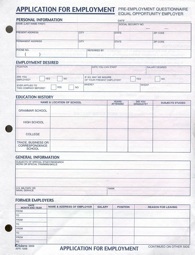
Page 1 of An Actual Radio Job Application

A Radio Show Host Writes:

“I’m applying for a job, and one of the questions on the application form is ‘Expected Salary.’

“What should I put here in order to avoid throwing a jinx on future salary negotiations?”

My Reply:

Assuming there is no one standing over you, making sure that you fill in every line, I recommend simply leaving it blank.

If for some reason that is not an option— if someone returns the application to you and insists that you fill in that line — I recommend writing something like:

“To be determined.”

Your other option is to enter the highest possible salary you think the job might pay. If you’re hoping for $90,000 but you’d settle for $75,000, write “$90,000.”

The two potential problems with this are:

1)  If the radio station could pay more for that job, you’ve limited yourself.

2)  If the station’s budget for that job is far less than that amount, you might be removing yourself from consideration. (Actually, this is the lesser of the risks. If you need $75,000…or $60,000…and the station won’t go higher than $30,000, you won’t come to terms regardless of what you declare as your expected salary.)

{ 9 comments }

First, give this radio commercial a listen….

This is both bad advertising and bad writing.

Why begin with “It’s a fact that your smile is one of the first things that people notice” when instead they could say, “Your smile is one of the first things that people notice”? Did they add “it’s a fact” because they felt the need to fill time?

What is the single Core Message (the one thing you want the targeted listener to hear, to understand and to remember) that you take away from this commercial?

• Better smile?

• Great teeth?

• If you need a dental implant but haven’t been able to afford it? (More bad writing, by the way: “…but haven’t been able to afford the cost.” Real people say, “I can’t afford it.” Radio announcers reading badly written copy say, “I can’t afford the cost.”

• Price for a dental implant?

• Price for a dental implant crown?

• Combined price for the dental implant plus dental implant crown?

• Price includes all initial tests?

• Price includes CT scans?

• Price includes x-rays?

• Price includes oral sedations? (So I guess you don’t have to bring your own.)

• 12-month “same as cash” financing? (What is this, a used car dealer commercial?)

• Free consultation?

• Loose dentures?

• Ever been told you need a bridge?

• Missing one or more teeth?

• Need a tooth removed?

• Wearing old-fashioned dentures?

“Sure, no one will listen to the message. But if we give our phone number four times, that will make us some money…”

{ 8 comments }