The latest issue of my Radio Programming Letter includes my list of “Ten Shocking Truths For Radio People,” as well as a critique of a subscriber’s aircheck.
This posting is for subscribers to add their own comments….
The latest issue of my Radio Programming Letter includes my list of “Ten Shocking Truths For Radio People,” as well as a critique of a subscriber’s aircheck.
This posting is for subscribers to add their own comments….
If you’ve been “thinking” about signing up, here are 10 pretty good reasons to turn your thoughts into actions.
Dina Boland: “I just wish that I hadn’t jumped in this business without having this class first, because I made just about every mistake in the book. Believe me, this is a must class for anyone getting started.
“There is no other workshop out there that offers the indispensable info that this class provides, so I really hope you would offer this to others as well. There are just too many folks out there that want to separate you from your money in this biz without giving ANY practical information. Those probably are the two words that best describe this class: Practical Information.
“Value points for me:
“— Got me to take action: HUGE!!!! I was stuck.
“— Gave me a specific direction: how to look for work, where to look for work, the importance of branding, know what I want and where I want to eventually be and how to approach getting there, ideas on how to make calls, what should be said, the importance of doing your research first….
“— Gave me specific information — equipment, what mic/preamp is best for me, etc.
“— Gave me guidance and specifics on how to build and run a VO business — taxes, lawyers, accountants, finances, corporations, unions, management tools, how to approach an agent, taking responsibility for my success.
“Honestly, without this class I’m pretty sure I’d still be on my butt trying to figure out what to do next. I was stuck, and I had that whole analysis paralysis thing going on because I was afraid of making mistakes.
“I’m all amped up to move forward. I was always excited and motivated to get going but had no idea how to proceed. Thank you for giving me direction. This is THE one class that should be bottled and sold. No lie.”
Tom Daniels: “For once in my life, I feel completely satisfied that I have received more than my money’s worth. Far more than I EVER expected! Thank you for providing the tools that will undoubtedly enable me to transform my Voiceover business into a profitable career. For me it was a life-changing experience!”
Deborah Reast: “This is my second business and it is a division of my first company, so much of my company accounting and legal aspects are already in place, however, during the last session I picked up two accounting ideas that I will begin using immediately. Anyone just starting out surely will have their business run much more smoothly because of the information they received in Module 4.”
Brooke Boland: “Wonderful information you can get your head around. I like the step-by-step format, the homework. Much more relevant and user friendly than the other class I took, in which they didn’t focus at all on the business, which is key…as you and Harlan emphasize. I really got my money’s worth!”
Susan Smart: “Each class was awesome. The best things I’ve gotten out of the overall set are how to move forward and what to expect…and something even better: what is expected of me in so many aspects of the business. Sometimes when I don’t know what to do, I become distracted and start doing so many different things it takes me a long time, if ever, to get back to where I should be. These classes have allowed me to set a path/plan that I can refer to when I get sidetracked, so I’m back on track right away.”
Bob Souer: “In 2009 I was about to make a transition from having a day job plus a full-time voiceover business to only having a voiceover business in the very month when Harlan Hogan and Dan O’Day were doing just such a telesminar series. I knew it was going to focus on the business part of the voiceover business.
“As it turned out, that series of 4 weeks of teleseminars really helped me sharpen my focus on my voiceover business at that critical point of stepping away from my corporate day job. It was some of the best money I spent that year.”
Linda Ristig: “Today, I’m shifting my focus to researching and contacting potential clients. My biggest stumbling block was the ‘management’ piece. If I begin to make contacts, how do I keep track of that effectively? The two sessions in Module 4 answered those questions.”
Melissa Freeman: “This was by far the best voice-over class, best seminar, best all around course in a creative field, period.
“What was totally refreshing is the crispness of the presentation, topics and details covered; I loved the nicely designed Study Guides too! The follow-up with a subsequent Q & A class dedicated solely to the previous night was great, and the entire class format was consistent and did not deviate or become randomized or lose ground and time retracting steps or jumping ahead on topics that were ahead in the course.
“The hands-on approach was totally beneficial and the assignments really put us though our paces in the research and analysis of genres of voicing, branding, competition and Internet casting sites. The peak in this endeavor was being able to record ourselves and receiving a critique of our sound in handling the mic and our studio set-up and any hardware and/or software problems by a super expert in the field, Jeffrey Fisher.
“I also so appreciated the generous, valuable and incredibly interesting bonus classes! The bonus classes were totally unexpected — and they were phenomenal!”
Kerri Parr: “I can’t thank you enough. I’m blown away by all the preparation and unbelievable amount of information. Everything has been very consistent and and so well organized. The homework assignments have helped me get more organized; make an action plan and TAKE ACTION on it; follow through on my voice over commitments; know the competition; zero in on where I fit in, my strengths, and what I’m passionate about; target the best site, if any, for me to sign up with; determine the best course of action toward moving forward in my career.”
Tim Petersen: “You have given us the tools to rebuild our careers as voice actors. I can now tear down what crumbly foundation I had, to rebuild on a new and more solid foundation you have given us. I thank you and our fellow classmates for making this the BEST VO class available.”
Register here for STARTING YOUR VOICEOVER BUSINESS: Everything You Need To Know To Turn Your Dream Or Your Sideline Into A Business.

For the past few weeks, in response to a reader’s request, I’ve offered advice to new radio program directors.
This week, without being asked, I offer an odd piece of advice to PDs who’ve been programming for more than a couple of years:
A good radio program director already reads industry trade publications (online and off).
Make it a point always to be reading, in addition, at least one non-radio, non-business book.
No, I am not referring to books about your hobbies (e.g., fishing) or your passions (e.g., your religion).
My bookshelf contains lots of books about radio, marketing and advertising. Those don’t count.
Also lots of books about my extra-curricular interests: psychology, stage magic, and blackjack. (A long time ago I was a serious — and winning — blackjack player. For the three or four players reading this, I’ve got collector’s editions of Thorpe, Wong, Revere, Humble, Andersen, Braun….)
(Side note: Many years ago I ordered what since has become “the” classic blackjack book by “the” big blackjack name. It arrived in the mail with a note from the author: “Are you the Dan O’Day I used to listen to on the radio in San Francisco?” Made my day.)
None of those “hobby” books counts.
Neither do the books by my favorite novelists.
So what books “count”?
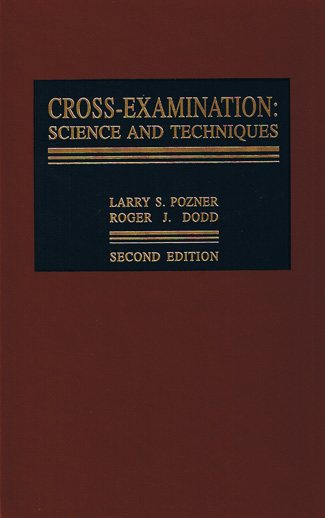 CROSS-EXAMINATION: SCIENCE AND TECHNIQUES by Larry S. Pozner and Roger J. Dodd. 761 pages, for trial lawyers. I bought it new for $95.
Didn’t get around to reading it for a few years.
Ended up creating an entire commercial copywriting seminar around the book’s techniques.
Wait!
Back up.
When I bought the book, I had no idea I’d ever use it “professionally.” Something about it simply caught my interest.
Ended up being a very cool seminar.
 Another weird book: THE EARLY HISTORY OF DATA NETWORKS by Gerard Holzmann and Bjorn Pehrson.
Flipping through an in-flight magazine while en route to a seminar somewhere, I came across a fascinating article about an optical “data network” — mirrors reflecting signals from station to station to station across hundreds of miles — that existed in Europe a few hundred years ago.
Amazed at what I read, I subsequently bought this book by the article’s authors.
At the turn of the 18th Century, well before the electromagnetic telegraph was invented, many countries in Europe already had fully operational data communications systems, with close to one thousand network stations.
This book documents the many attempts throughout history to develop effective means for long distance communications. (The oldest recorded attempts date back a couple of thousand years and include ingenious uses of homing pigeons, mirrors, flags, torches, and beacons.)
Haven’t figure out how to use this information yet, but my mind is richer for having read the book.
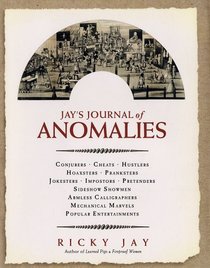
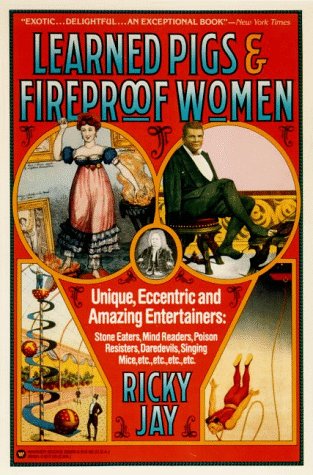 If you’ve been looking for an incredible, mind-blowing promotion that will set your market on fire, invest in JAY’S JOURNAL OF ANOMALIES or LEARNED PIGS & FIREPROOF WOMEN, both by Ricky Jay.
You won’t find any radio promotions in either book. But you’ll be inspired by the lengths to which people throughout history have gone to entertain or influence others.
(I personally can’t count those two books as “weird,” because Ricky Jay is a card magician. So they fit among my magic books.)
Why should you read weird books?
Because when you expand your areas of knowledge and interest, you add to your creative toolbox.
One way to insure your success as a radio programmer is to have access to as rich and varied a toolbox as possible.

The opening line of a radio commercial is the commercial for the commercial.
Unfortunately, that’s a concept the people who create Albertsons’ radio advertising don’t understand…
Ostensibly, this radio ad is aimed at shoppers who would appreciate more thorough nutritional labeling on grocery products.
But you wouldn’t know that from the opening line:
“With over 40,000 food items at Albertsons” — That’s it, game over. They’ve declared that this spot is about how many food items there are at Albertsons.
They just couldn’t resist boasting about how many products they stock — even though the number of items they stock is irrelevant to the “enhanced nutritional labeling” message.
Fact: The average customer doesn’t evaluate 40,000 food items during a typical trip to the supermarket.
Fact: The “40,000” figure is meaningless without being placed in a context that enables the listener to conceptualize it.
Fact: The misplaced bragging has no value even as a boast, because if you’re not in the supermarket business you have no idea if 40,000 food items is more, less or about the same as the number of food items carried by most large supermarkets. To the consumer, that number is meaningless.
And the “40,000” figure truly is meaningless to this commercial’s supposed message because that is not the number of food items that Albertsons includes in its “Nutrition IQ” program. That number is much smaller than 40,000.
Halfway into the commercial they say, “It’s like shopping with your own personal nutritionist.” Oh! You mean this radio ad is not about Albertsons’ 40,000 items? Too bad the targeted listeners already have stopped listening.
Oh, and thanks for telling us that fresh fruits and vegetables have lots of vitamins and minerals. Golly, we had no idea! We thought fresh fruits and vegetables are bad for our health.
And then there’s that God-awul, inane music bed. Did adding that music to the announcer’s voice increase the effectiveness of the sales message in any way?