≡ Menu

THE RADIO MICROMANAGER SYNDROME

radio station programming

A program director writes:

Being a former PD and jock, my GM/Owner insists on being involved in every aspect of what I do. He has criticized my choice of music in a promo. He’s insisted I word a promo in a certain way. He hovers over my shoulder when I’m working on ProTools, whether it be a station promo or a commercial.

I dread Monday mornings because I fear his detailed checklist of what went wrong over the weekend. I dread his rundown of the mistakes my afternoon jock makes. He assures me that she is leagues better than the former afternoon announcer and that she does a good job…but, “Why does she have to use those phrases? And she repeats herself….And….” Then he goes to her and questions her about the same things.

I know that I should be happy that I have a GM who is interested in the way the radio station sounds, but MY GOD…I have a job to do. I am the Program Director. He’s the General Manager. He has my department to oversee, the office manager to oversee, the sales staff to oversee. OVERSEE…not DO. I feel like I am a glorified DJ. One who signs affidavits but certainly can’t make any decisions.

His presence in the production studio stifles creativity because he wants you to explain what you’re doing as you do it. He wants to hear success as soon as you load the workparts in. How often have you had a brainstorm on a promo and walked into the studio…hoping it would turn out…and when it didn’t you’d try it again when you’d have a fresh perspective? Well, there was a time I did that, too.

His inability to give up control of promotions and small details of radio station operations makes me feel very underappreciated. He calls his constant criticism “brainstorming.” He refers to his complaints as “managers’ meetings”…when in fact they take place in the studio while I’m trying to do my airshift.

His interference with the talent questions my authority. It totally undermines my aircheck sessions and makes the talent feel like they can’t try anything creative…for fear that he will come running in and question them. Whatever the talent and I are trying to overcome via aircheck sessions and random taping is undermined by the fact that he will bring it up to me every morning that “she’s getting too wordy again.”

It makes me look like I don’t make any decisions regarding talent and that they really don’t need to talk to me about anything; they should go to him. His response is, “The day I, as GM, can’t talk to one of my workers is the day I lock the doors.”

Keep in mind, I am not some part-time DJ that he brought up from weekends to be PD. I have been in the business for 11 years. I know what I’m doing…and I probably will continue to learn and make mistakes.

I don’t necessarily want to change radio stations. I have ties to this community and I do like the station. My only worry is the stress factor that he gives me. What I would like is suggestions on how to improve my working relationship with him. Perhaps ways to gain his trust without simply bowing to his wishes and doing things his way. I am trying to do good radio, not just his radio. I would like to be the Program Director I know I can be and not his personal assistant.

Your GM may or may not have been a good jock and a good PD. But if your description of him is accurate, then as a General Manager he is incompetent.

He has two fatal weaknesses.

1. He doesn’t understand what a manager’s job is.

A good manager is a facilitator; it’s his job to do whatever it takes to enable his staff to perform to the peak of their abilities.

“Enable” does not mean “dictate.” It means providing the tools, training, motivation and resources necessary for them to do the best job possible.

If all of his employees truly need to have him micromanage every aspect of their work performance, then he should resign immediately…Because obviously he is completely incompetent at hiring effective people.

2. He has not learned how to delegate.

“Delegating” does not mean requiring you, as PD, to do everything exactly the way he would do it. It means appointing a responsible person to take charge of a task or of a job…Making sure that person has the tools necessary to do the job…Monitoring that performance on an overall basis (not minutely)…And then getting out of that person’s way and letting him do his job.

An excellent resource from time management expert Harold Taylor: How To Delegate Effectively.

What can you do about this situation?

1) Hope that a miracle occurs and he takes steps to become a more competent, professional manager.

2) Stop trying to be a real PD and settle for being his lackey.

3) Consider other career options.

{ 2 comments }

ALWAYS BETTER RADIO PRODUCTION: How Difficult It Is

LEAP OF FAITH RADIO PRODUCTION with Bobby Ocean

radio advertising graphic

The idea of a way better type of production sounds great. We all look for an edge. Having found one, and then putting it into practice, however, is something else.

Something one has to do alone.

Learning to expand one’s abilities, broaden diversity and “let go, and allow more of the story (promo/commercial/format theme) to tell itself” requires you to slightly elevate your awareness. Teaching it to take seriously those intuitive impulses, those leaps of faith, can only be done by one. The practitioner. That’s you.

Yet, you will not be affected. You will be only be educating your previous education. Think of it as a simple professional faith update.

To make things more compelling, however, let’s put a ticking time bomb under the dinette table: miss your specific time to act, leap the Leap, and your chance explodes.

Yes. A specific date, year, lunar cycle, and all the other movie suspense elements. Miss it by one split-second, and the chance is gone. Forever.

Only with your alertness, practice and quick response can you make the choices in production, occurring within a fraction-of-a-second Leap Of Faith, flashing past before you can form a thought.

The notion of taking a Leap of Faith can seem difficult. But, with a little insight, not at all. It’s simply not apparent. Not at first.

Let me tell you the story of one person who decided to go as deeply as one can, in Letting Go. Quick, simple tale. At the end of the story perhaps you will see the practice differently.

This person I speak of took the ultimate Leap of Faith. He gave up everything. His identity, his connections to the business, his status. He let go of his most beloved, his wife, his children, siblings and kin. His ego became disconnected and he was without motivation or personal gain of any kind.

What he did was he went to sleep.

There was no promise that he would awaken. Nowhere among his possessions was a guarantee he would return from his slumber. But he did it anyway. Falling into nightly sleep was a leap of Faith on his part.

Oh! Next day, he woke up. And everything started up with his awakened awareness. Up popped the ego, the sense of entitlement, the ambition. There were the people among which to choose to pay more or less attention. He continued as if nothing were different.

So – it’s not only as easy as that, taking a Leap of Faith is also  something from which we will survive! Well now, that’s important to know.

And, as for that one chance you have to take a Leap Of Faith. That’s all any of us ever have. But when? An easy way to remember is to once again bring to mind there is no REAL Past, no Future, only that to which we can refer. So –

These are your coordinates, you may want to write them down if unable to commit them to memory:

Here is the precise time for action.

Now is where everything is and will take place.

You are the only one to choose… a Leap Of Faith.

[Disclaimer: Your estimates, perceptions and outcomes may vary; better results with selfless action.]

{ 0 comments }

RADIO (MIS)MANAGEMENT

radio programming graphic

When I read this in Monday’s L.A. Times, at first I thought I’d turn it into a nice little sarcastic Tweet.

But then I realized how monumentally arrogant, destructive, and irresponsible this defense of management blunders is…

…and for some reason it reminded me of certain radio executives I’ve encountered over the years.

In an article about Universal Pictures’ year of flops, studio President Ron Meyer is quoted as saying, “90% of our decisions were the right ones with the wrong results.”

Either the reporter didn’t think to question the validity of that assertion or an editor deleted the follow up question. (Because the Times appears to have, at most, one fulltime copy editor, I’m guessing it’s just bad reporting.)

Think about that: “We made the right decisions. It was the results that were wrong. Don’t blame us; blame the results.”

Huh! And all along I’ve been thinking it’s the results that tell you if the decision was right or wrong.

Have you ever experienced someone like that in your radio career?

“The last five jocks I hired turned out to be such losers. I can’t believe how incompetent people can be.”

“It was a great promotion. Too bad the stupid audience didn’t respond the way they were supposed to.”

“Deregulating and consolidating absolutely were the smartest things to do. The only reason they appear not to have helped radio is we need more deregulation and consolidation.”

{ 9 comments }

radio commercials graphic

You’ve heard me say this before: Award-winning radio commercials rarely are good commercials. They are radio commercials that entertain the judges.

But maybe you haven’t heard lots of “award winners” and you’re not sure I’ve been telling you the truth. So let’s resume our visit to a number of spots honored as “the best of the best” by the 2007 Radio Mercury Awards.

As I selected commercials to share with you, I followed just one criterion: Was there something about the spot that stood out?

Sometimes — okay, rarely — that something that stood out made it an effective commercial. More often, an entry stood out because it was so staggeringly bad.

You be the judge.

This long running campaign is clever and entertaining and funny and fun to listen to. It has a good wear (or “burn”) factor; you can enjoy the individual spots even after multiple exposures.

But if you’re not already a thoroughbred racing fan, no matter how many times you listen to it you’re no closer to wanting to go watch thoroughbred racing.

They didn’t sell the experience of a day at the track. They didn’t create any mental pictures of the excitement of thoroughbred racing.

You can hear this 100 times and enjoy it 100 times but still never even consider becoming a customer (or “patron”).

This is the kind of campaign that wins awards.

It’s the kind of campaign that will thrill the advertiser because it is clever, and when the advertiser’s friends, vendors and employees hear it, they will compliment the advertiser.

If the NTRA is spending its advertising money as an internal morale boosting campaign, it’s a pretty expensive ego trip.

{ 1 comment }

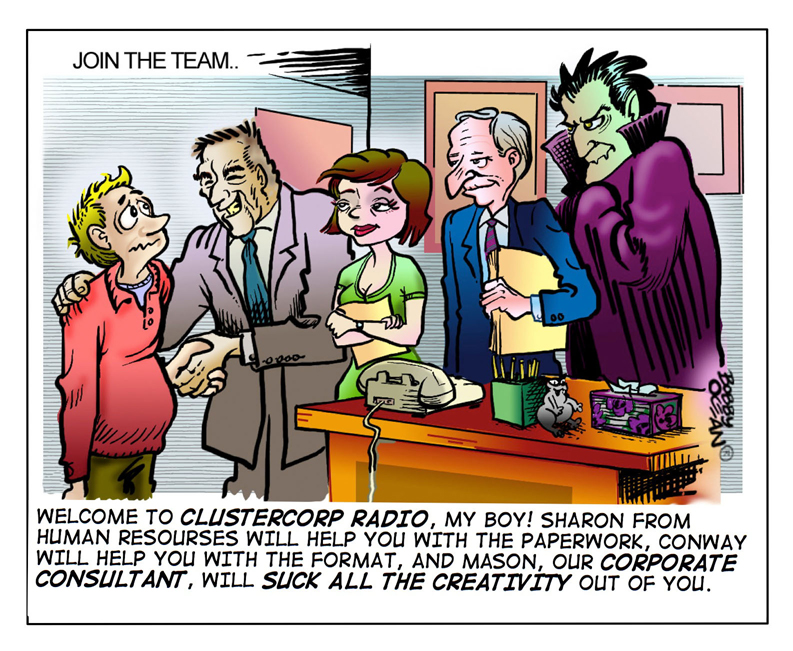
CORPORATE RADIO WELCOMES TALENT

radio programming DJ graphic

Illustration © 2009 by Bobby Ocean

{ 11 comments }