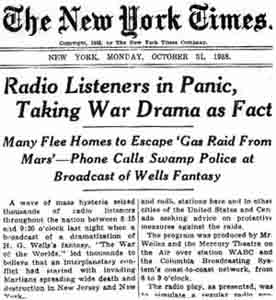
It was 71 years ago yesterday that The Mercury Theatre “panicked the nation.”
Orson Wells and others share their recollections.
It was 71 years ago yesterday that The Mercury Theatre “panicked the nation.”
Orson Wells and others share their recollections.
September, 1995: New Orleans was the site of this year’s NAB Radio Show, where I presented The Total Quality Radio Station.
Edison Media Research’s Larry Rosin — who moderated a panel at the convention — insisted that he wanted to buy me a nice dinner there .
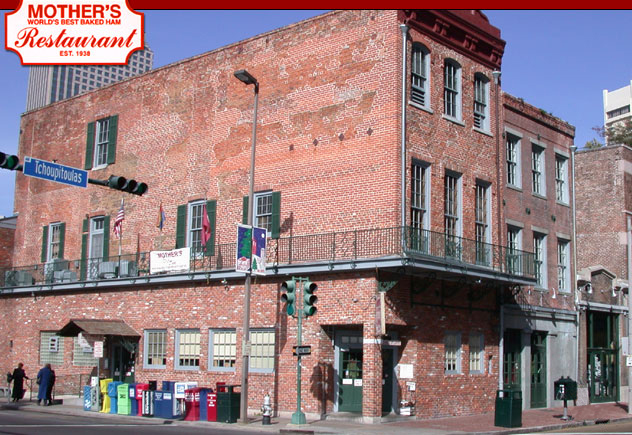
So on my first evening in New Orleans I followed him a couple of blocks from my hotel to a diner called “Mother’s,” where I ordered the most expensive thing on the menu — a $7 sandwich. Which I paid for. (At least the sandwich was good; I’d go back there.)
I left the convention a day early, because the following day I had to put on a tuxedo for the second time that year (and, actually, that decade) in order to attend the Emmy Awards here in L.A.
I’m pretty sure I was the only guest who drove up in a 1981 Toyota Tercel. (I prefer to think of it as a “classic automobile.”)
Walking past the screaming fans and frothing paparazzi, I swear I could hear people murmuring, “Who the heck is that??”
I had decided not to wear the suspenders that came with the rented tux; why bother to indulge in such a silly affectation? Only upon arriving at the Emmys did I realize that they do hold your pants up. So I had to walk with one hand at belt-level, constantly tugging to keep my trousers up. (I’m a very classy guy. And there’s more to come.)
Next time you watch an awards show (assuming that you have nothing better to do with your life), notice how you never see any empty seats when the camera pans the audience. But…What about the winners who leave their seats to claim their awards? What about the people who get up to use the restroom during the multi-hour event?
Their seats temporarily are filled by “seat fillers” — formally dressed young men & women who stand on the sidelines, out of camera range, and rush forward to take the place of anyone who vacates (even temporarily) a seat. No, they don’t get paid for this…and they even have to provide their own fancy clothes.
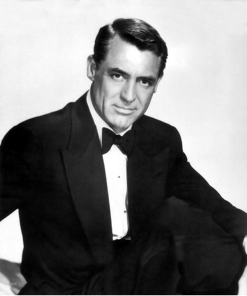
Cary Grant

Dan O’Day
Separated at birth?
I assume that even my seat was filled when, midway through the show, I went to the rest room.
There was a line of tuxedo’d men waiting to get in. Immediately in front of me was an older gentleman talking on a cellular phone. Here is what he said:
“Look, I’m about to go into the bathroom now. I’ll call you back. I’ll call you back. Look, I’ll call you back. I’ve got to go now; I’ll call you back. I’ll call you back, okay? I’ll call you back….”
Somewhere between my auditorium seat and the bathroom, I lost a cuff link. For the rest of the evening I kept shirt cuff fastened with a safety pin. (I know what you’re thinking: I remind you so much of Cary Grant.)
LEAP OF FAITH RADIO PRODUCTION with Bobby Ocean
Today’s radio, nearly unrecognizable to, say, a Pams Pureblood or Hippy Reveler from the 60s or a disciplined Boss Jock from the 70s, even now operates on what I call “universals,” or ideas of a timeless quality.
One of the “universals,” the simple telling of a Story, as one example, is just as appealing today as it was when Broadcasting originated from Broadway in New York City over 70 years ago, with twenty-something Orson Welles as its reining King.
Our current state of radio, still in flux and motion, continues to use Stories every day, whether they are in the form of a commercial, a polarizing opinion on a talk show or a night time love song dedication.
And there are many more methods than before that can be employed to successfully hold the listener’s attention through your Story. Styles have been developed, patterns have been recognized and plotted. Now small armies of technique-hybrids inferred from extrapolations of these archetypes are suddenly available and at the ready, just in time for the new inclusive digital age.
As they have always been, they are all here waiting to be individually discovered by you and me.
In addition to Stories, there are plenty of other “universals” in great abundance for broadcast craftspeople to be found in all corners of the Big Tent.
Sales people have their tricks, some really cool ones. Production Alchemists have bags full, as do Voice Performers, Engineers, Disc Jockeys and General Managers.
That’s one of the things that made me fall in love with radio. It is a portal to Infinity.
 I teach a number of pretty sophisticated QuickStart Copywriting Techniques — meaning they’re easy to apply but not so easy to teach in a blog posting. But here’s one that is easy to explain, and it never fails:
Think of someone whom you really care about, whom you’ve known for a long time — maybe someone from whom you’re geographically separated. Write that person a letter, and in that letter do everything you can to convince that person to buy the product or service.
Don’t give them a sales pitch. Talk to them in whatever style you usually use with them. Start with “Dear Bob” or “Hi, Mary” or “Hey, wassup” or however you would begin a letter to them.
Obviously, you need to pick someone who would benefit from the product or service. But put away the bullet points and just write from the heart.
If you’re trying to convince a nearsighted friend to try Lasik Eye Surgery, you’re not going to talk about how many procedures the doctor has performed or his friendly, knowledgeable staff.
Don’t allow any advertising-ese in the letter. If you write it from the heart, in 5 to 10 minutes you’ll have the basis of a good commercial.
That might mean that you can simply edit it down to commercial form, or it will lead you to an appropriate emotional approach to take when you write the spot.
It’s almost always sure to lead you to at least a few good lines to use in your copy.
When I’ve taught this at workshops, I’ve heard wonderful, original, stunning commercial copy that lifts right out of that letter.

A Loyal Reader writes:
“I’m a young jock who was just fired from a small-market station. I got fired because they thought I was looking for a job and because they thought I was trying to get people to leave.
“I am #1 in the market. I was happy, but they didn’t give me a contract. I have Internet radio experience, and they wanted to capitalize on that without paying me more.
“I got some interest from different stations and so I sent them T&R’s. I was always told that you don’t say anything until you get an offer and then you give your bosses a chance to counter offer. Am I wrong?
“Management said they wanted to solidify the staff and that I was bad for morale because the sales staff was worried about me leaving.
“What do you think I should do? I am just scared that they would try to do something to me for talking to you. Please don’t mention my name or location.”
My Response
What could they do to you? They’ve already fired you, haven’t they?
“I was always told that you don’t say anything until you get an offer and then you give your bosses a chance to counter offer.”
That’s a risky strategy. If you seek work elsewhere primarily to try to drive up your price where you’re already working, you open yourself to the possibility of your current employer refusing to meet your demands and bidding you adieu…while you don’t have a contract elsewhere.
You sent airchecks & resumes to other stations. Unless your goal was simply to waste their time, then the clear message was that you’re “available” and that you’re not particularly eager to stay with your current employer.
Let me put it this way: If your wife sees you at a singles bar, she might question your loyalty. (You might wonder what she’s doing there, too, but that’s another story.)
“What do you think I should do?”
If you have hopes of getting your job back, your best shot is to arrange a meeting with the GM, explain that you acted out of naivete and not out of lack of loyalty, and ask for a second chance. If your GM is considerably older than you, he or she might remember making similar mistakes as a young employee.
But I think there’s an additional factor you need to consider, and I think it’s a strike against you:
“I got some interest from different stations and so I sent them T&R’s.”
That makes it sound as though numerous other stations contacted you, and you responded to their interest by sending T&Rs. If that were true, it would be dumb on your part; why send a T&R to a station that is trying to recruit you?
But if it’s more than one station, my experience tells me that you approached them. And if that’s the case, you really can’t expect your then-current employer not to get upset.