≡ Menu

SHOW PREP FOR OTHER RADIO DAYPARTS?

radio show prep graphic

A Loyal Reader Asks:

“Why is the morning program the only time of the broadcasting day that’s addressed by show prep services? I work afternoon drive and find myself having to adopt and adjust most of the humor because it’s written/slanted to the morning programming/presentation.

“I understand that it’s the morning portion of any radio station that sets the precedence for the day’s broadcasting. It’s the morning show/ personality that first relates to the listeners and it’s their job to get things rolling. It’s when you can first talk about what happened the day before because it’s fresh. And it’s when you can relate to what’s in store for today because it’s early in the day and expectations are high.

“But what about the rest of the broadcasting day? It’s just as important for the midday and afternoon drive to keep them, and entertain them. I constantly feel left at the altar when it comes to things I can choose from and use in my show.

“Now I may be wrong. Perhaps there’s a wealth of smartly written prep directed to the afternoon drive floating around out there some place and I just haven’t found it yet. If so, would you kindly direct me to it? It would be nice to have other things to say and relate to that’s not been rewritten or adjusted from the leftover morning stuff I find.”

My Reply:

I don’t believe it’s’s accurate to say that most prep services are predominantly for morning shows. The good prep services offer information and ideas that can be adapted by any air shift. Very little of the material I see has a “mornings only” orientation.

All prep material must be adapted by the user if it’s to be used effectively and wisely.

Listeners want to be entertained, often in some way informed, regardless of daypart.

An afternoon show might have to do more “looking ahead” than a morning show, which can spend more time “looking backward” at the previous night’s entertainment news.

But other than entertainment news, afternoon prep has an advantage over morning prep because before you begin your shift, nearly a full business day has passed, and lots of stuff has happened that simply was not available to that day’s morning show.

It’s your job to adapt the materials from your prep services to fit your own style & audience as well as to add your own personal takes on whatever has happened in the day’s news.
{ 2 comments }

radio broadcasting graphic

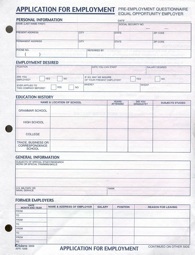
Page 1 of An Actual Radio Job Application

A Radio Show Host Writes:

“I’m applying for a job, and one of the questions on the application form is ‘Expected Salary.’

“What should I put here in order to avoid throwing a jinx on future salary negotiations?”

My Reply:

Assuming there is no one standing over you, making sure that you fill in every line, I recommend simply leaving it blank.

If for some reason that is not an option— if someone returns the application to you and insists that you fill in that line — I recommend writing something like:

“To be determined.”

Your other option is to enter the highest possible salary you think the job might pay. If you’re hoping for $90,000 but you’d settle for $75,000, write “$90,000.”

The two potential problems with this are:

1)  If the radio station could pay more for that job, you’ve limited yourself.

2)  If the station’s budget for that job is far less than that amount, you might be removing yourself from consideration. (Actually, this is the lesser of the risks. If you need $75,000…or $60,000…and the station won’t go higher than $30,000, you won’t come to terms regardless of what you declare as your expected salary.)

{ 9 comments }

First, give this radio commercial a listen….

This is both bad advertising and bad writing.

Why begin with “It’s a fact that your smile is one of the first things that people notice” when instead they could say, “Your smile is one of the first things that people notice”? Did they add “it’s a fact” because they felt the need to fill time?

What is the single Core Message (the one thing you want the targeted listener to hear, to understand and to remember) that you take away from this commercial?

• Better smile?

• Great teeth?

• If you need a dental implant but haven’t been able to afford it? (More bad writing, by the way: “…but haven’t been able to afford the cost.” Real people say, “I can’t afford it.” Radio announcers reading badly written copy say, “I can’t afford the cost.”

• Price for a dental implant?

• Price for a dental implant crown?

• Combined price for the dental implant plus dental implant crown?

• Price includes all initial tests?

• Price includes CT scans?

• Price includes x-rays?

• Price includes oral sedations? (So I guess you don’t have to bring your own.)

• 12-month “same as cash” financing? (What is this, a used car dealer commercial?)

• Free consultation?

• Loose dentures?

• Ever been told you need a bridge?

• Missing one or more teeth?

• Need a tooth removed?

• Wearing old-fashioned dentures?

“Sure, no one will listen to the message. But if we give our phone number four times, that will make us some money…”

{ 8 comments }

RADIO TALENTS’ LOVE AFFAIR WITH CONSULTANTS

Illustration © 2010 by Bobby Ocean

{ 0 comments }

The current issue of my Radio Advertising Letter discusses:

• The Federal Trade Commission’s new guidelines for testimonials and endorsements in advertising

• The importance of having a Client Protection System

This post is for my subscribers to use to add their own comments, thoughts, rejoinders, etc.

{ 5 comments }