≡ Menu

radio programming Finland

April 1996 (continued):

Unfortunately, I reached Helsinki’s Hotel Pasila later that evening than originally was planned.

I say unfortunately because I had been hoping to do something I rarely do on a night before a seminar (a “school night,” I call it): leave the hotel.

But in the hotel’s Visitor Guide I had read that the Helsinki Theatre Group was presenting a production of West Side Story — “partly sung & spoken in English.”

The thought of seeing a Leonard Bernstein musical about Puerto Ricans performed in Finland in both Finnish & English was irresistible.

Instead of an evening of musical theater, I enjoyed a very nice salmon dinner at the hotel restaurant. The salmon, by the way, came with French fries.

(In the U.S., fries often come with hamburgers or other sandwiches, but rarely with a “fancy” meal like salmon.)

Not wanting to be easily identified as an American, I resisted the impulse to ask for ketchup.

Before eating, however, I asked the hotel’s Reception desk if they had an electrical adapter I might be able to use. Oddly, I appeared to be the first guest ever to make that request, and they had nothing I could use. And there were no stores close by that might carry such an item.

But, I explained, I need to plug in my computer. Maybe I should take a taxi downtown in search of an adapter? Or is there some other hotel nearby that I could check with? (It really isn’t unusual for hotels to stock such items for their guests.)

One of the front desk clerks offered to phone a sister hotel elsewhere in Helsinki. She made the call and then excitedly informed me that the other hotel did have such a device. I arranged for a taxi to pick up the adapter at the other hotel while I ate my dinner.

After lingering over the salmon and fries (sans ketchup), I returned to the Reception desk. They handed me the oldest, rattiest-looking frayed adapter imaginable. It literally fell apart in my hands. Apologetic, the desk clerk explained it’s the only thing they could find.

I took it up to my room, attached it to my computer, applied some expert jiggling, and managed to transfer current from the wall to the Powerbook.

An hour later I went downstairs to let my friends at the Front Desk know it had worked. When they saw me approaching, the two women there froze with fear. I don’t know that I’ve ever seen anyone appear more relieved than they did when I told them the good news.

(During another European seminar trip several months later, I experienced an unexpected coda to this story when I returned to the same Helsinki hotel. But I report these things chronologically, so you’ll have to wait a few weeks before hearing about it.)

My second day in Finland was spent speaking talking with 10 of YLE’s producers in their headquarters, just down the street from the hotel. For lunch we had Beef Lindstrom (ground beef with sauce). At the end of the day it was back to the airport to fly first to Stockholm and then on to Växjö, Sweden.

Next Installment: Stuck in a hotel with 400 Swedish student nurses…

{ 0 comments }
radio advertising clothing boutique

It's our people that make the difference!

When I conduct advertising seminars for business owners and ad agencies (usually sponsored by a local radio station or radio group), often the formal seminar is followed by a Client Hot Seat session. Business owners volunteer to sit onstage with me, one at a time, while I helped them identify their own Unique Selling Propositions.

A while ago, one of the volunteers owned a women’s apparel store. I asked what sets her store apart from her competitors.

“The two things I always talk about are service and selection,” she replied. “That’s what makes us different.”

Uh-oh. Every store says it’s got the best service and selection. And as a result, no one believes their commercials.

So I probed deeper, asking questions more or less at random until we discovered this store’s preemptive advantage.

DAN: Do you have competitors?

CLIENT: I would say our biggest competitor is the mall.

DAN: Why should someone come to your store to shop instead of at the mall?

CLIENT: Because we have service, we are easy to get to; you don’t have to haul yourself to the mall.

You can turn around in our store and not knock ten things off of a rack. We have qualified salespeople.

We have what I consider a really good selection.

The two things I always talk about are service and selection. That’s what makes us different.

DAN: The only problem with what you identify as the two things that make you different is that’s what all stores say.

All stores say, “What makes us different is our service and our selection.”

Now if you can prove this quantitatively — if you can say:

“If you go to the store at the mall to buy a bathing suit for this summer, you’re going to be stuck with the two choices they’ve already made for you. Because they only carry these two major brands that they can sell the most of, in limited styles and limited sizes. They sell a ton of them and they make a lot of money that way, however….If you come to OUR store, you’ll find 36 different kinds of bathing suits. We aren’t limited to those two manufacturers like the mall store is” —

— If you can quantify it. If you can truthfully say, “You might not know this, but according to Retailer’s Monthly Magazine the average women’s clothing store in a shopping mall has only X-number pieces of apparel, while our store has 4-times-X,” that can be powerful.

But everyone is going on the air or in print and saying, “We have a wide selection,” and nobody believes them.

And with Service, everyone says, “It’s our people who make the difference.” With the implication being, I guess, that their competitors don’t employ people; they employ robots or androids.

But if you are going to say, “Every one of our salespeople has passed an intensive, six-week course in Fashion,” then you can say:

“Who do you want helping you? Do you want the teenaged girl with the safety pin through her nose working after school at the mall, or do you want one of our Fashion Consultants whom we sent to Chicago for a six-week course at the Design Center where they learned about color and fabric and how to flatter someone’s face and how to work with a mature woman’s figure?”

That’s a great selling point. But when you say it’s your salespeople who are different, is there anything that objectively separates them from your competitors’?

CLIENT: Yes, because I spend a lot of time making sure they’re knowledgeable about their product.

DAN: How do you do that?

CLIENT: Because I’m there.

DAN: But what is it you do to make sure they’re knowledgeable about their product?

CLIENT: I talk to them.

DAN: Do you quiz them?

CLIENT: No. But I make them active in decision-making. They see the product from the minute in comes in the back door to the minute it’s hanging on the rack. They work on the floor.

DAN: Now this is interesting. What happens when the product comes in the back door?

CLIENT: They open the box and they hang it up.

DAN: Is there discussion? Do they talk about where it’s going to go or who they expect to buy it?

CLIENT: Yes, all of those things.

DAN: What kinds of things do they say?

CLIENT: (Laughing) Depending on whether they like it or not?

DAN: Sure!

CLIENT: “Isn’t this cute?”

“Oh, that’s a really pretty color.”

“I wonder if this matches that other item that we already have on the floor.”

“Oh, I should call Suzy Smith; she’ll love this.”

“Can I order one for myself?” (That’s a common one.)

DAN: At the big stores at the mall, are the sales clerks there when the big boxes are unloaded?

CLIENT: No.

DAN: Are the salespeople there when the clothing is put on display?

CLIENT: It comes in on rolling racks; I don’t know who puts it out on the floor.

DAN: Now this could be something different, a terrific commercial in which we hear — literally record the room when a new shipment comes in and we tell your staff, “Look, we’re recording this, but just forget about us and go ahead and have fun.”

I think it would be a wonderful commercial if we hear the salespeople. Your salespeople are mature women, matching your customer base?

CLIENT: Yes.

DAN: So we hear these women joyfully greeting the truck — “Oh, at last! I thought you’d never get here!”

“Sign here.”

And then the boxes are unloaded from the truck, and we hear them ripping open the boxes:

“Oh, this is beautiful!”

“You know, we have a yellow frock in the front window. We should put these two together; this would really go well with it.”

“You know who would like this? Suzy Smith. She comes in every few months, and she always says if we ever get something with daisies on it, we should tell her.”

That could be edited into a commercial.

You can say, “In a typical clothing store in a big shopping mall, the sales clerk first sees the dress at the same time the customer does. But at our store, here’s how it happens….”

I think what you’ve just described is wonderful. I didn’t know that’s what happens when the merchandise first arrives at a boutique, and I’ll best most consumers don’t know that either. That’s great.

You can say, “This is how it is at our store. If you want, you go can to the big department store at the mall and you’ll get a different high school girl every time, and if you can get her attention between texting her friends to ask her a question she’ll say, ‘I don’t know; I think they’re in back’…Or you can come here.”

That’s a great commercial.

And maybe when they go through the new arrivals, they won’t like something. Maybe they’ll say, “Who would wear that??”

CLIENT: No, their favorite phrase is, “Who bought this??” And that would be me, because I do all the buying!

DAN: There are so many different things you can do here. This could be part of a running gag:

“Oh, this is beautiful…Oh, I want this one for myself.”

And then at the end, “Let’s see what’s in this last box.”

And there’s a long pause, and then: “Who buys this???”

And then you come in and say, “Hi, I’m So-And-So, I buy it! I buy all the clothes here. I think everything I buy is great; my staff usually agrees with me. Why don’t you come and see what you like the most?”

In fact, you could have a “Who Buys This??” Special of the Week:

Who buys this?? Who wants to wear a green pantsuit?””

And then you say, “Well, my staff thinks I’m crazy. But we got a great deal on it, I love the fabric, it will be very cool for summer. Come down to our store; we have it on display. Cast your vote: Should we send it back?”

It becomes an interactive aspect of your advertising. Anyone who hears that commercial and comes to your store will be sure to look at that green pantsuit. They’ll want to know if you’re crazy or if your staff is crazy.

You could hand out buttons to the staff that say, “WHO BUYS THIS??”

But even if the process you described of what happens when the merchandise first arrives is typical of what happens at small clothing shops everywhere, your customers don’t know that. And sharing this with them in your advertising will set you apart in their minds.


{ 0 comments }

radio promotions

If you ever have radio contest winners come to your station to pick up their prizes, make sure your receptionist understands that these people are not “freeloaders.” They are honored guests who should be treated accordingly.

All too often, however, the contest winner arrives at the radio station only to discover that no one there seems to know anything about the contest, the prize, or the fact that this active listener was asked to be there.

Instead the receptionist says to the winner, “Our promotion director is out to lunch right now. You can sit and wait, if you like.”

And then when the promotion director does arrive, he or she typically treats the winner as a nuisance:

“Here’s your prize, you creep! Now get out of here. I’m much too important to be polite to you; I’m the Promotion Director.”

Contest winners should be treated like royalty, like guests of honor.

Your receptionist should have an up-to-date list of all winners, along with the contests and prizes they have won. The receptionist should be trained to greet these active listeners warmly and make them feel welcomed and comfortable.

The promotion director should do the same.

And the promotion director should make a big deal about the winner’s visit:

As you’re walking down the hall, grab one of your jocks and introduce him to the winner…knowing that the jock, too, has been trained to greet the winner warmly and enthusiastically.

Take the winner’s picture with the jock, and post it on your website as part of your online Radio X Winners Hall of Fame.

Whip out your Flip video camera, shoot 30 seconds of the excited winner posing with the jock and hoisting the prize, upload it to YouTube and then embed the video on your blog or website.

And after you have given the winner her prize, taken her on a tour of your radio station, excitedly introduced her to some of your co- workers, and taken photos and videos, what do you do just before she leaves?

You thank her: for listening, for entering the contest, for visiting the station to collect her prize.

Why should you do all that? After all, she’s getting the prize, not you.

Why?

Because you want to make her experience with your radio station so positive that she will want to listen to you again, to enter your contests again, and to tell her friends what a great bunch of people you are.

{ 3 comments }

WHICH FACEBOOK PASTIME WOULD YOU BANISH?

facebook radio

Mari Smith

Sure, Mari Smith might be known as the “Pied Piper of the Online World.” But as she explains in this brief video clip from PD Grad School 2010, even she draws the line at some Facebook pastimes…

Which leads me to wonder:

Are there any particular Facebook that you could easily do without?

{ 0 comments }

orthotics radio advertising

First, the radio commercial:

“Hi, how can I help you?”

Okay, they’ve already repelled the audience with that 100% fake “How can I help you?”

I keep saying this, but some people ain’t hearing it:

Your opening line is the commercial for your commercial. It’s your one chance to attract the attention of your target audience.

“Hi, how can I help you?” doesn’t attract anyone’s attention. It’s a complete waste of commercial time.

Granted, it’s tough to identify their targeted listener through this thicket of audio weeds, but they’re trying to attract the attention of people who need “orthotics.”

Of course, they don’t bother to tell us what “orthotics” means. After all, many of the people who work for Dr. Scholl’s probably know the word…even though the woman providing the voiceover probably doesn’t.

Advertising Solves Problems. No one awakened this morning with thinking, “Darn it! I’ve got to solve my orthotics problem!”

But lots of people want to get rid of problems that Dr. Scholl’s might be able to help with: Foot pain; arch pain; back pain; bunions; heel pain; knee pain, etc.

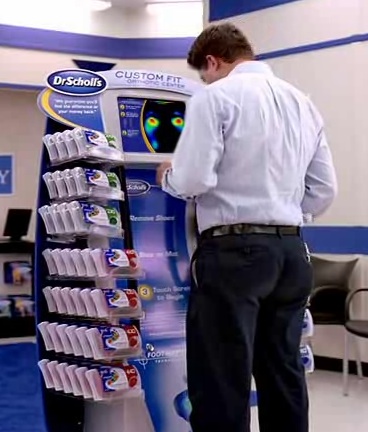
“What is that COOL looking machine in the pharmacy?”

Please identify the universe in which an adult would get so excited about the “cool looking machine” that’s pictured above.

“Wow! How does it work??”

Oh, I get it. He’s President of PWAEI — People Who Are Easily Impressed. Wait until he sees the electric can openers on Aisle 4.

“This amazing foot mapping technology…”

This woman works in, one surmises, a large supermarket. (Because Mr. Easily Impressed says “in the pharmacy,” they must be speaking somewhere close to but not inside the pharmacy.)

What would her answer REALLY be? “Oh, it’s a machine that you stand on and it tells you tells you what’s wrong with your feet.”

“Go ahead, give it a try.”

WAIT A MINUTE! This conversation is not taking place inside the pharmacy. How is he giving it a try?

Not only were they magically transported to the machine; apparently Mr. Golly Gee Whiz entered the store sans shoes. She tells him to give it a try and wham! he’s already standing on the thing in his stocking feet and it’s given him the readout.

And now…His feet are smiling.

You’re expecting me to ridicule that. But this poor guy is suffering from a chemical imbalance and desperately needs to get back on his meds.

Meanwhile…

If they can show us  in a 15-second TV commercial the kind of problem Dr. Scholl’s can solve, why can’t they do that in a 30-second radio spot?

{ 1 comment }