Let’s say you had a particularly frightening or traumatic experience.
A car crash.
The FIRST time you tell someone about it:
“I’m driving down Vine Street, minding my own business, when out of NOWHERE this HUGE SUV runs a red light and SMASHES into me!”
But after years of telling that story, the drama in your voice disappears:|
“Someone said you once were in a bad car accident.”
“Yeah. Years ago. Some idiot ran a red light and t-boned my Chevy Impala. Destroyed my car…and I had wear a neck brace for 3 months….”
(If you want to get deep into the how-the-brain-works weeds: At that point, you’re not remembering the incident itself. You’re remembering yourself telling people about it.)
If a character is relating an incident that occurred long ago, they don’t add drama to “NOWHERE” or “HUGE SUV” or “SMASHES.”
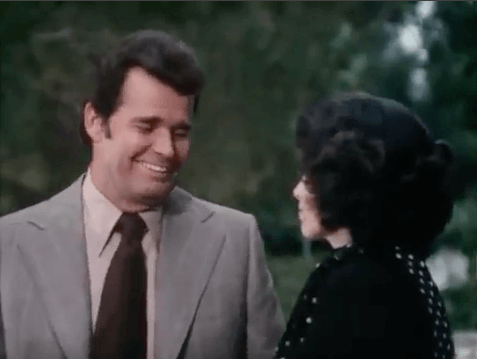
In this clip from The Rockford Files, James Garner demonstrates what I mean.
The first time I heard this, I knew exactly what it was:
The audio track of a TV or video spot.
For many years it has been common practice for ad agencies to send radio stations the audio from TV commercials to air as radio spots.
That’s almost always the sign of an agency that’s either lazy or ignorant.
The audio of an effective video ad almost always supports the visual images…but the visual images tell the story.
In fact, a good test of a TV commercial is if the viewer is able to perceive the message while the audio is muted.
I heard this one on Spotify.
“Aha! Then it was streamed with some sort of visual accompaniment — a video or, at least, a static image that reinforces the ‘branding’ effect of the campaign.”
No.
Yes, probably it did have a visual component.
But no, most listeners never saw it.
Most people who listen to Spotify rarely if ever “look” at the commercial.
(The exception is for “Video Takeover Ads,” which appear only when users are engaged in activity for which they must be looking at the screen — for example, searching for a particular artist, song or genre.)
Listeners to this spot who know nothing about “Batteries Plus+”still know nothing about that advertiser.
Advertising should be optimized for the medium via which it is delivered.
“Audio taken from a video ad” rarely results in optimal use of the client’s radio advertising budget.
More often, it’s the equivalent of advertising malpractice.
This is one of the dumbest YouTube video ads I’ve seen.
If you’re a typical YouTube viewer, when a video ad delays the beginning of the video you want to watch, you wait for the “Skip Ads” option to appear and then get the hell out of the ad.
I’m not attacking YouTube’s employment of skippable in-stream ads.
This one for Forward Healthcare keeps showing up, and each time it does I want to scream.
Those first 5 seconds are crucial.
In a radio spot, the opening line is the commercial for the commercial. It’s your one chance to grab the attention of your targeted listener.
Those first 5 seconds of the video ad are the advertiser’s one chance to prevent — or, at least, delay — the viewer’s clicking on that “Skip Ads” option.
This particular ad devotes 80% of those first 5 seconds to:
“Hey, guys, welcome to Forward.”
Robert Collier famously observed that the key to successful advertising is to enter the conversation the targeted consumers already are having.
How many of YouTube’s 2 billion viewers are thinking, “Golly, I wish I could learn more about Forward”?
Relatively few.
The final 20% of the non-skippable intro consists of:
“We’re a new type of doctor’s office that’s –.”
Number of viewers who are thinking, “I wonder if there are any new types of doctor’s offices”:
Not a lot.
Probably this “new type” of doctor’s office is intended to solve some sort of problem for some group of people.
This ad has 5 seconds to interest that group, either by identifying that problem or getting the keen attention of people who are affected by that problem.
This video ad is just plain embarrassing.
If you create advertising for any medium, be smarter.
Paul Simon says his song, “Stranded in a Limousine,” comes directly from Elvis’Mystery Train.
I don’t doubt it, but I can’t hear it. He’s referring to music theory and structure, which I barely understand and which he understands to the nth degree.
On the other hand, the other day Spotify segued from Elvis’ There’s Good Rockin’ Tonight to Creedence Clearwater Revival’sBad Moon Rising…and I realized “Bad Moon” is the progeny of “Good Rockin’.”
If you’re familiar with both records, you might hear what I mean….
I’m sure they were around during Vaudeville, and I’ll wager they existed centuries earlier.
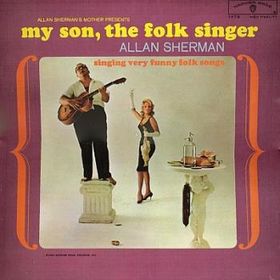
Alan Sherman is recognized by many contemporary song satirists as the father of the current art form.
But it was a song parody that launched the types of nationally produced comedy services that prevail today.
In the early 1980s, Katz Broadcasting put together a team — led by Andy Goodman and The Real Bob James — to create produced comedy features for the five Katz stations across the country.
This small company-within-a-company was dubbed “American Comedy Network,” and they insisted they had no intention of offering the service to non-Katz stations.
From the very beginning, I suspected that’s exactly what they planned to do.
But regardless of their intent, American Comedy Network was changed irrevocably by an integral component of the American communications revolution of the 1980s: the break-up of the telephone company.
In case you’ve already forgotten (or are too young even to remember), the relationship between consumers and “the telephone company” used to be much different than it is today.
For one thing, that’s what it used to be: “The Telephone Company.”
No one had to ask “which one,” because you had no choice.
For most of the country, if you had a telephone in your home or office, you were a customer of Bell Telephone — also known as “Ma Bell” — whether you wanted to deal with Bell or not.
Ma Bell provided your local phone service.
Ma Bell provided your long distance service.
And I’ll bet you almost forgot this part — Ma Bell provided the actual telephones you used.
You didn’t own a telephone; you rented one from Ma Bell… paying for it each and every month, forever.
For the lowest monthly rate, you got an ugly black, rotary telephone.
For a couple of dollars more, you could get a touch tone model.
Or one in a color other than black — but you had to pay extra.
And then the telephone industry was deregulated.
Suddenly, consumers were told they could choose from among a number of long distance carriers.
No longer did they have to rent a telephone from Ma Bell at exorbitant rates; they could go out, buy their own telephone, and plug it into the wall.
Naturally, consumers all over the country responded to the news of their liberation the same way:
They were outraged.
To quote Kris Kristofferson — although as I recall, his song wasn’t really about the phone company — American consumers as a group longed for “the freedom of their chains.”
Sure, as a monopoly Ma Bell made huge profits.
Sure, the company treated its captive customers with disdain.
Sure, their newly emerging competitors — like Sprint and MCI — were offering consumers a chance to save money on long distance calls.
But we felt safe with Ma Bell, benevolent dictator though she was.
People didn’t want to have go out and buy a telephone — especially because Ma Bell’s advertising campaign at the time did its best to scare us into thinking that if we didn’t use one of their telephones, we’d forever find ourselves talking into dead transceivers and, probably, our houses would catch fire, too.
Also, in the mid-1980s, the “alternative” long distance services offered real savings but provided genuinely inferior sound quality.
One of the pervasive problems was “skipping” — that second-and-a- half delay while the signal went from the earthbound transmitter to the satellite and then back earth— which consumers experienced as an annoying “echo” effect, not infrequently hearing their own voices through the receiver as they spoke.
Believe me, people were upset.
And — with perfect timing — ACN recorded a song parody, to the tune of Neil Sedaka’s “Breaking Up Is Hard To Do.”
Now that you know the history of this song (and of the American telephone system), here’s the parody version.
As I recall, the piece was written by The Real Bob James, Andy Goodman, and David Lawrence; the overall music production was done by Bob Rivers.